Showing posts with label Pulitzer. Show all posts

Rating : 4.5/5
Number of Pages : 282
Format : Fiction, Novel
Reason for Reading : Book Awards Reading Challenge II

In 1956 seventy six year old Reverend John Ames begins writing a journal to his young son who is not yet seven. His first wife died in childbirth and his daughter very shortly after and he does not fall in love again and remarry until he is in his late sixties. ONe of his biggest regrets is not being able to get to know his son before he dies and he has been diagnosed with a heart condition

Life changes when fellow minister and close friend Boughton's black sheep son and John's namesake comes back into town. There was a scandal when the he was a young man and he left somewhat in disgrace. John is torn between warning his family about young Boughton as he is worried he will take his place at the head of his family after he dies. As both stories unfold you learn John's reasons for being fearful as he compares their two lives and what could have been if young Boughton had been his own son.

This is a slow novel that really captivates the reader. Very descriptive and beautiful and I got really into it the mre I read and was unable to put it down. It's hard to put down my thoughts even though I finished this a week ago, it's such a hard novel to pin down. It is definitely one that will linger in my mind for a long time to come.

The Good Earth by Pearl S. Buck

Pearl S. Buck's classic story of family and life in pre-revolutionary China. This did not take as long as I thought, and while sad at times, I liked the book. I think the prose is distinct, the story compelling and honest, and the characters very real. I liked the themes of the novel which explored man's relation to the earth, changing fortunes, China at the turn of the century, and women's role in society and family. She writes everything so deftly and without judgment; a very true story teller. I am very familiar with Chinese culture, family, and livelihood. Buck said she wrote about China because it was all she knew. She might have been a foreigner, but there is such an candid and wonderful perspective in her writing. Dare I say it, but this book is very Chinese. It is difficult to describe how she captured the Chinese characters and cultural identity so well. Once again, I found so much honesty in her writing. I liked how she painted the picture of O-Lan and the other women in Chinese society. While I appreciated the writing and the book, I do not think I will continue with the trilogy because I am not particularly attached to the characters beyond this book, and the stories can be rather sad. I would be interested in reading more of Buck's other stories.

Crossposted from aquatique.net.

The Complete Maus - Art Spiegelman

Art Spiegelman tells his fathers story as a Jew in Poland during the Second World War in comic book format. The Jews are drawn as mice, the Germans as cats, the American's as dogs and the Polish as pigs. This is a truely harrowing story with lots of cross roads and choices made along the way with Spiegelman showing what happened to the familes who chose the alternative along the way.

His mother and father against all the odds managed to survive the war as well as being POWs in Auschwitz seeing many of their friends and family die in the camps and by Germans along the way. They are dehumanised, starved, beaten and betrayed along the way. Sadly his mother later killed herself in 1968 after suffering for depression for many years (since before the war) and writing this brings on a bout of depression also for the author who includes sections from his life whilst writing this comic.

Art and his father have a very strained relationship and he is often conflicted with how to write about him. He wants to remain true to their relationship whilst not living up the to the JEwish sterotypes. This is shown very well in the panels below.

His father is also racist and anti-communist which Art struggles with after knowing what he lived through at Hitler's persecution. He can't understand how someone who has been on the recieving end of such abuse and violence can perpetuate the same against another. The main thing is though that he cannot image the horrors his mother and father lived through. It is one thing to have them described, but it can never be the same.

Defintely a tale that sticks in the readers mind. Very personal and filled with tragedy and sadness, it is difficult to remember at times that this is a story of courage and survival. That anyone Jewish in Poland and Germany managed to survivie the war is a miracle and I hope one that is never forgotten. This is essential reading.

Beloved review by Athena

This Pulitzer Prize winning and critically acclaimed novel is very sad and includes many stories of horror and trauma. The persistence of memory and the past is part of the novel from a mother's obsessive overprotection to the reconciliation of people's past personal and with slavery as a whole: "To Sethe, the future was a matter of keeping the past at bay. The 'better life' she believed she and Denver were living was simply not that other one."

The narrative shifts with a stream of consciousness writing towards the end of the book. It also reminded me of an even more twisted version of Oscar Wilde's The Portrait of Dorian Gray by that time.

It's a complex novel, but very beautifully written. I love the prose. It is difficult to read due to the story and plot, but the literary prose is wonderful. Morrison is also very adept at characterization. I get a total sense of these characters whether or not I agree or actually sympathise with them. She presents them so clearly and honestly. It is not a pleasurable read, and like many books literary books, it is not for everyone. It's difficult, but honest and well written.

Gilead review by Athena

This Pulitizer prize winning book by Marilynne Robinson is the definition of modern literary novels. The novel does not have much in the way of plot. It is an epistolary novel of an old man writing for his very young son about his life. It is extremely introspective and beautifully written. I do not think it is for everyone, but I could relate to it because I am like the character and the style. It is not to say that I think as the character does all the time, but I certainly do understand why they mean with lines such as this:
I don't know why solitude would be a balm for loneliness, but that is how it always was for me in those days, (p 18-9 hardcover)

It is the kind of book I can see myself rereading because it reminds me of so many things of myself and my inner world. It is introspective and reflective, spiritual and pensive:
Our dream of life will end as dreams do end, abruptly and completely, when the sun rises, when the light comes. And we will think, All that fear and all that grief were about nothing. But that cannot be true. I can't believe we will forget our sorrows altogether. That would mean forgetting that we had lived, humanly speaking. Sorrow seems to me to be a great substance of human life. (104)

Such passages like this are why I would not recommend it to everyone. It took me awhile to read this book because I knew how reflective of myself it was, and how moody I was to avoid such deep thoughts. Many people, even bibliophiles would not necessarily enjoy this book. It is not everyone's cup of tea especially since it does talk of faith and God, but not necessarily in an obtrusive way. I think it would vary for each individual's faith. Here a particularly spiritual passage:
Calvin says somewhere that each of us is an actor on stage and God is the audience. That metaphor has always interested me, because it makes us artists of our behavior, and the reaction of God to us might be thought of as aesthetic rather than morally judgmental in the ordinary sense. How well do we understand our role? With how much assurance do we perform it? I suppose Calvin's God was a Frenchman, just as mine is a Middle Westerner of New England extraction. Well we all bring such light to bear these great matters as we can. I do like Calvin's image, though, because it suggests how God might actually enjoy us. I believe we think about that far too little. It would be a way into understanding essential things, since presumably the world exists for God's enjoyment, no in any simple sense, of course, but as you enjoy the being of a child even when he is in every way a thorn in your heart. (124-5)

I have quoted from the book so much in this review because I really love and can relate to the words, prose, and style so much. The tone is like my own when I write in my journal, but obviously not as well written. I think there a few people who can appreciate such a work, but they truly will if they read it. It's not for everyone, and I am one of those reviewers who ultimately review for myself so I would not recommend it at all if you do not think you can enjoy an introvert's novel. I do want to reread this again which says enough about how much I like this book.

Here are some more exerpts:
When I'm up here in my study with the radio on and some old book in my hands and it's nighttime and the wind blows and the house creaks, I forget where I am, and it's as thought I'm back in the hard times for a minute or two, and there's a sweetness in the experience I don't understand. But that only enhances the value of it. My point here is that you never do know the actual nature even of your own experience. Or perhaps it has no fixed and certain nature. (95)

Remembering when they said what they did about looking in windows and wondering about other people's lives made me feel companionable with them. I could have said that's three of us, because as the Lord knows, for many years I did exactly the same thing. (202)

Oh!, I will miss the world! (115)


Crossposted from Aquatique,net

Pulitzer Prize 1940, The Grapes of Wrath

By John Steinbeck © 1939
Published by Penguin Books Ltd.
1940 Pulitzer Prize Winner

Review posted at my blog, Needles and Pens.

7th book - Middlesex


Winner of the Pulitzer Prize, 2003

This beautifully written book is more than a story of a hermaphrodite. It is a rich family history interwoven with the history of Greek immigrants, as well as a history of life in the Detroit area from the early auto industry through the Civil Rights movement in the 1960s. I liked all the characters from the grandparents Desdemona and Lefty through the narrator, Cal/Callie.

More book information here.

Middlesex - J's Review

Middlesex, by Jeffrey Eugenides (author of The Virgin Suicides), is first and foremost the story of Calliope, a young Greek girl growing up in the suburbs of Michigan, and how at puberty, she becomes Cal, a young Greek boy.

The story spans three generations, starting with Desdemona and Lefty, a brother and sister fleeing Greece during the war with Turkey in 1922. Unfortunately, Desdemona and Lefty are in love with each other, and the anonymity of fleeing their homeland for America gives them the opportunity to start over, as husband and wife. Their story is a sad one, because as Desdemona discovers the dangers of birth defects involved if they have children, she becomes a distant and frustrated wife.

Their son, Milton, is a successful entrepreneur who marries his second cousin, Tessie, sealing Calliope's fate. Calliope is born with a birth defect, 5-Alpha-Reductase Pseudohermaphordites, which means that though she appears to be a girl, she has both girl parts and boy parts, though the boy parts are more difficult to see if you're not looking. It takes a bit of a stretch of the imagination to believe that her doctor wouldn't notice, that her mother wouldn't notice while changing her diaper, but since the story isn't graphic in its detail of the physical abnormality, you can give them a pass. Genetically, though, he's a boy, with XY chromosomes and a desire for women.

The story travels back and forth across time, as the narrator, 41 year old Cal, tells the story from the beginning, from his grandparents' love affair and sad marriage, to the success of his father's hot dog franchise and the race riots of 1967 Detroit, and on to Cal's own coming of age, his fear of not knowing exactly what was wrong with him, but trying desperately to hide the fact that clearly, something was.

Did I love this book? No. I thought it could have been about 150 pages shorter (it weighed in at 529 pages). Some of the details went on too long for me, and I found myself a little bit bored. It took me quite awhile to read this book, though the second half sucked me in, and I read the last 300 pages in just the last few days. I'm not sure I can recommend this book...like I said, it just didn't suck me in enough. But anyone interested in trans-gender issues, or in the experience of three generations of a recent immigrant family, might enjoy the book more than I did.
March
By Geraldine Brooks
Completed April 11, 2008


What happens to a family when a husband and father goes to war? Many books explore this question, and one of the most famous is Little Women by Louisa May Alcott. But what about the husband and father - how is he impacted by the war during and after the battles are fought? For these questions, we can rely on the fantastic storytelling of Geraldine Brooks and her Pulitzer-winning March.

In this novel, we learn about Mr. March who was away during Little Women, which offered a creative canvas for Brooks’ story. March, an active abolitionist, enlisted as an army chaplain at the beginning of the Civil War. His service took many twists and turns before he ended up on a Yankee-controlled plantation, where he taught former slaves how to read, write and do math. While there, he fell victim to “the fever” and later a bullet, which forced him to a hospital in Washington, D.C.

Readers of the original Little Women may envision Jo’s father to be a docile, patient, kind-hearted man who made more good decisions than bad. Furthermore, one might expect Marmee March to be the typical antebellum wife and mother – silent, obedient and sinless. Brooks took a different path with these characterizations, however, in March. March was, in fact, very fallible whose idealism cost him (and his family) their fortune and almost March’s life. Marmee March was an impulsive hot head, constrained by the societal and marital norms of her time. Together, their marriage had secrets and miscommunications, which sounded very “normal” to me. Other readers may prefer Alcott’s original depictions, and if you’re one, I recommend skipping March because you will feel frustrated by the Marches.

While this story explored slave conditions and the horrors of the Civil War, the war’s toll on March left the biggest impression. He emerged hopeless and depressed. I think of war veterans now and realize that nothing has changed. We need to do a better job in helping our service men and women when they return to civilian life – whether we agree with the war or not. To me, that’s the biggest lesson I learned from March. The affects of war are timeless, and if you are interested in the social and psychological impacts of war on men, women and children, I would recommend March to you. ( )

(Cross-posted from my blog)

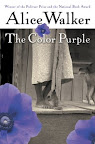
The Color Purple by Alice Walker

This is one of those books that I love so much that I am hesitant about trying to write about it for fear of trivializing it in some way. I reread this book in February, but was unable to even approach writing about it until I decided to just do one of these questionnaires so that I can be walked through the process.

Title and author of book? The Color Purple by Alice Walker

What led you to pick up this book? I've read it before, probably twice, maybe three times. This year, I saw the movie for the first time, which made me want to reread the novel.

Give a brief summary of the plot: The main character, Celie, grows up poor in an abusive household. In fact, it seems like everyone she knows is abusive or abused, so it seems normal to her -- this is probably a result of the crushing despair of poverty. She's married off young to a man who continues the pattern of abuse. He's also in love with another woman, a woman who becomes Celie's friend.

What did you like most about the book? For me, the most moving part of the story is Celie's separation from her sister; my favorite part of the book has something to do with this separation, but to talk about that would be a huge spoiler. I also really like the letter structure of the novel, and I like the use of dialect in this book, even though dialect is usually distracting for me. And I really love the way Celie grows into a level of strength that allows her to start standing up for herself somewhat.

What did you like least?There isn't anything I could really say I dislike about this book, but some scenes are disturbing. For me, the most difficult scene is the one in which a friend of Celie's is beaten and imprisoned for trying to stand up for herself.

What did you think of the writing style? The writing is amazing. As I said above, it's epistolary and uses dialect. Some parts are written in standard English, and those beautiful passages only serve to highlight the simplicity of Celie's uneducated writing and speech. But don't get me wrong; Celie's words are also beautiful. It's amazing to me how Walker manages to write in these two different styles, and make both of them so full of insight.

What did you think of the main character?: I can remember that upon my first reading of this book, I felt frustrated with Celie. She tolerated such terrible treatment, and I was angry with her. I think I have a better understanding of human nature now, so I realize that Celie is a person who has spent her entire life so beaten down -- and not just by individuals, but by society as a whole -- that it's impossible that she could have lived her early years of adulthood in any other way. During this reading of the novel, I was able to notice Celie's gradual strengthening, and rather than resenting Shug's presence in Celie's life at all, I was able to see how she helped Celie grow. I was also able, this time, to appreciate the way women in the book support each other and give each other a sense of community in a world that completely marginalized women of their era, race, and socioeconomic class. Not that the men of their era, race and socioeconomic class fared much better.

Any other particularly interesting characters?Most of the words of wisdom are given to Shug and to Nettie. I think that Walker gave her own voice to those characters at times. They are both amazingly strong and they both overcome terrible circumstances through a combination of luck, talent and introspection.

If this book has been made into a movie, and if you’ve seen the movie, compare the book to the movie. If you've only seen the movie, if you liked it, you should really treat yourself to the book. The movie leaves out so much.

Share a quote from the book: I'll share two, so that you can see the contrasts mentioned above.
The years have come and gone without a single word from you. Only the sky above us do we hold in common. I look at it often, as if, somehow, reflected from its immensities, I will one day find myself gazing into your eyes. Your dear, large, clean and beautiful eyes.


And this is Celie, speaking of her stepson (Harpo) and her husband (Harpo's daddy).

Harpo no better at fighting his daddy back than me. Every day his daddy get up, sit on the porch, look out at nothing. Sometime look at the trees out front the house. Look at a butterfly if it light on the rail. Drink a little water in the day. A little wine in the evening. But mostly never move.

Harpo complain bout all the plowing we have to do.

His daddy say, You gonna do it.

Harpo nearly as big as his daddy. He strong in body but weak in will. He scared.

Me and him out in the field all day. Us sweat, chopping and plowing. I'm roasted coffee bean color now. He black as the inside of a chimney. His eyes be sad and thoughtful. His face begin to look like a woman's face.

The Road by Cormac McCarthy--Gautami's 10th book

Cross posted from my blog..

Title: The Road
Author: Cormac McCarthy
ISBN: 9780330448628
Publisher: Picador
Pages: 307
Rating: 5/5

I won The Road from Melody in the BAFAB week in a book drawing. This book was a coveted one. Cormac McCarthy won the Pulitzer Prize for 2007 for this book. After reading it, I thought rightly so. Not all award-winning books are readable. This one is. Once I started it, I could not put it down.

It is a story, if we can call it that, about a father and a son who remain nameless throughout the narration. Both are walking through America, which has been ravaged by fire. They are walking towards south to the coasts. On their way to it, there is nothing but ashes, burnt trees, and soulless houses. They have each other and a pistol for a company. They pass through dead towns, looted houses, finding corpses on their way. They are afraid to meet other fellow human beings. Men who kill for food, for any kind of food.

The Man all the while tries to save the boy. Love and despair go hand in hand. Without the boy, he would have been dead long ago. Survival is the key. He does all he can to save himself and his son. However, he also prepares the boy to survive in case he is no longer there. The interactions between the father and the son is very interesting. We do not see dialogues, only narration. The Man instils moral values in the boy even in great adversity. At certain places, we see that he is not disappointed. His son has risen above the father.
The sparseness of languages enhances the harshness of the situation. This is what makes it chilling, scary and very gripping. If we do not take care of our Earth, this might become a reality. A forest burning is not a new phenomenon. The same reaching out cities and destroying can become a fact. What is shocking is that it can become a reality. The nameless people could be us…

Language used can be called poetry in prose. One pauses at certain places to enjoy the sheer beauty of words. One feels sad. However, there is hope too at the end, a salvation of some kind. This book should be read by all. Those who do not care for the Earth and those who truly love it.

Laura's Review - March

March
Geraldine Brooks
273 pages


"Then what, pray, is the point?" His voice was a dry, soft rattle, like a breeze through a bough of dead leaves.
"The point is the effort. That you, believing what you believed -- what you sincerely believed, including the commandment 'thou shalt not kill' -- acted upon it. To believe, to act, and to have events confound you--I grant you, that is hard to bear. But to believe, and not to act ... That is what would have been reprehensible." (p. 258)

Louisa May Alcott's classic, Little Women, describes a year in the life of a mother and her daughters, while her husband is away serving in the Union Army. The father is absent for most of the book. In March, Geraldine Brooks brings the father's character to life and tells the story of that year from his point of view. Mr. March is a clergyman, so while he does not experience combat directly, he ministers to the wounded and dying. Initially, after a harrowing battle scene, he finds himself on a plantation that he had first encountered as a young itinerant peddler. Old relationships are rekindled, and he is reassigned to another regiment, and transported to a Southern estate under Union occupation. The slaves on this estate were under Union protection, and Mr. March was to provide them with the basics of an education. The novel's pace picks up at this point, and becomes considerably more violent as the horrors of war are revealed. March eventually lands in hospital, is visited by his wife Marmee, and returns home for Christmas just as he does in Little Women. In March we gain much more intimate knowledge of how the war scarred him, both physically and mentally, and how it affected his relationship with Marmee.

I was hooked on this story from page 1. Scenes from the American Civil War were interspersed with narrative describing how Mr. March came to be married to Marmee, their participation in the Underground Railroad, and his motivation for joining the Union army. He wrote letters from the front but, reluctant to burden his family with his daily horrors, he masked the truth. Marmee, on the other hand. felt lonely and resentful: "I am not alone in this. I only let him do to me what men have ever done to women: march off to empty glory and hollow acclaim and leave us behind to pick up the pieces." (p. 211) Their reunion was touched with both sadness and hope.

In letting her imagination run around the edges of Little Women, Brooks has written a memorable novel. Highly recommended. ( )

My original review can be found here.

So Big - Wendy's Review

"How big is my baby?" Selina would demand, senselessly. "How big is my man?" The child would momentarily cease to poke plump fingers into the rich black loam. He would smile a gummy though slightly weary smile and stretch wide his arms. She, too, would open her tired arms wide, wide. Then they would say in a duet, his mouth a puckered pink petal, hers quivering with tenderness and a certain amusement, "So-o-o-o big!" with the voice soaring on the prolonged vowel and dropping suddenly with the second word. - From So Big, page 2 -

Edna Ferber's Pulitzer Prize winning novel - So Big - is a superbly crafted novel and one I could not put down for long.

When Selina Peake's father is murdered, the teenager is faced with fleeing from the bustling streets of Chicago to Vermont to live with her stuffy aunts; or to strike out on her own to seek a life of adventure. She chooses a life of her own which takes her into the insulated farm country south of Chicago to live with Dutch farmer, his wife and three children. There she discovers the simplicity of farm life while teaching the young children of the community. Selina is brilliantly portrayed - a delicately boned, strong willed woman with sparkling eyes who sees beauty in everything - including the purple and green cabbages which provide sustenance for the hard-working farmers and their families. Even after marrying the solid and reliable Pervus DeLong and finding herself working long and difficult days as a farmer's wife, Selina never loses her vision of beauty.

There was born in Selina at this time a feeling for the land that she was never to lose. Perhaps the child within her had something to do with this. She was aware of a feeling of kinship with the earth; an illusion of splendour, or fulfillment. Sometimes, in a moment's respite from her work about the house, she would stand in the kitchen doorway, her flushed face turned toward the fields. Wave on wave of green, wave on wave, until the waves melted into each other and became a verdant sea. - From So Big, page 84 -

Ferber's novel is not just about Selina's voyage through life - her struggles and dreams, challenges and triumphs - but it encompasses a larger theme...namely that of living a life of beauty and joy vs. a life of material success. Selina's enduring spirit and vision of life never fails her throughout the story. One of the most memorable scenes for me was when Selina is widowed and facing the failure of her farm. She does what a woman of her community had never done - she drives a team of horses to market on the streets of Chicago.

"Never in my life did I hear of such a thing!" Selina turned the horses' heads toward the city. "You'd be surprised, Jan, to know of all the things you're going to hear of some day that you've never heard of before." - From So Big, page 115 -

Selina's son, Dirk (aka: Sobig) represents the flip side to the life she has chosen. By all definitions, he becomes successful - holding down a high paying job and living among the wealthy. But, Ferber carefully and succinctly shows the reader why this kind of success does not necessarily lead to happiness.

Ferber's novel has rich characterizations and a strong sense of place. Exquisitely crafted and lovingly plotted, it is story that is worthy of the Pulitzer. I will be reading more of this amazing author's work in the future.

Highly recommended; rated 5/5.

The Hours by Michael Cunningham


This is a book for the A to Z challenge as well as a Pulitzer Prize winner so I'm using it for the Book Awards Reading Challenge. I've read so much about this one on various blogs that I had to give it a read.

It is the story of three women in three different time periods; Virginia Woolf as she's writing Mrs. Dalloway (which is a book I highly recommend), Clarissa Vaughan as she's planning a party for a friend dying of AIDS, and Laura Brown, a suburban 1950s housewife. Cunningham interweaves the three stories in alternating chapters. I read Mrs. Kimble for the Book Awards Reading Challenge. It is also the story of three women yet their lives are intertwined with a shared husband, and they do interact in the book. The women in this book live in different times and places. Yet, Cunningham is able to make them seem remarkable similar.

Strengths of The Hours: The fact that he was able to make me care about these three very different women in only 200 pages is amazing. He basically told the story of one momentous day in each of their lives. For more of my review, visit my blog.

The Old Man and the Sea
by Ernest Hemingway
127 pages
First Sentence:
He was an old man who fished alone in a skiff in the Gulf Stream and he had
goneeighty-four days now without taking a fish.

This is the fairly mellow tale of an old fisherman who is trying to do what he was born to do: fish. Without a catch in 84 days, he is now being called "salao, which is the worst form of unlucky." But as he sets off on his 85th day, he is determined that it will be a lucky day. He is sure he will be catching a large fish this time.

This book moves at a leisurely pace in a stream-of-conscienceness way. The old man, being alone, thinks to himself and occasionally talks to himself too. The reader witnesses the old man's mental struggles with loving his fish while he also knows he must kill it. The agonies he goes through to catch the fish and then to protect it for the long trip home feel real.

It is about dreams fulfilled but at a cost. It is about a man's struggle with adversity. I am afraid that the simplicity of the story is hiding a much larger picture than I was able to grasp. It didn't win the Pulitzer Prise in 1953 because of its plot alone. It has a genuine quality about it. You believe this is the story of a real fisherman in the Gulf Stream. Largely uneducated, simple, loves fishing and the sea, content with his lot in life. I think the best description for it is pleasantly simple.

Miraculous Hours, two reviews by raidergirl3

The Hours by Michael Cunningham
Pulitzer 1999

I think I'd like the movie better. The narration is brilliant as Cunningham connects three women, three eras, and so many other symbols that I missed most of them. An homage to Mrs Dalloway and Virginia Woolf, my lack of knowledge and familiarity with both made this a less than impressive read. I acknowledge my lacking in this regard, not Cunningham's.
full review is here at my blog


Blooodletting & Miraculous Cures by Vincent Lam
Giller Prize Winner 2006

An interesting collection of stories, bound together by four beginning doctors, Lam's experience as an emergency room doctor gives a credible perspective, much like an ER episode. I like short stories, and novels loosely held together by some seemingly random threads, so I whipped through this book. I like finding the connection between chapters - how are these related?
full review here at my blog

The Bridge of San Luis Rey - Wendy's Review

Some say that we shall never know and that to the gods we are like the flies that the boys kill on a summer day, and some say, on the contrary, that the very sparrows do not lose a feather that has not been brushed away by the finger of God. - From The Bridge of San Luis Rey, page 9 -

Thornton Wilder earned the Pulitzer Prize in 1928 for The Bridge of San Luis Rey, which has been called his masterpiece. The novella (only 107 pages) begins in the summer of 1714 when a bridge of great construction fails and plunges five people to their deaths in the gorge below. A witness to the tragedy, Brother Juniper, embarks on a quest to prove divine intervention by exploring (in great depth) the lives of the people killed.

The book is essentially a lesson in philosophy - exploring the meaning of love, the twists and turns of one's life amid the greater scheme of things, and whether death is fate or God's plan. There are not any real answers to any of the questions - just the questions.

Wilder writes in old fashioned language and the novella is set in a foreign country with all the subtle references to politics and religion of the time. I admit to getting dragged down in it all and struggled to slog through and finish the book.

Wilder's character development is one of the strengths of the book; and Wilder does this within a very few pages which speaks to his gift as a writer. My favorite characters were the twins Esteban and Manual and I think Wilder does an apt job of presenting their relationship to each other and the devastation of loss that occurs between them. Wilder connects all the central characters to each other...something that took me by surprise...sort of like the six degrees of separation theory. Because of this I expected a resolution to the ultimate question: Could it have been fate that plunged these people to their deaths? Or something larger? But, Wilder apparently never intended to provide an answer. In the afterword of the book I read, the publisher shares a letter from Wilder to one of his readers:

'The book is not supposed to solve. A vague comfort is supposed to hover above the unanswered questions, but it is not a theorem with its Q.E.D. The book is supposed to be as puzzling and distressing as the news that five of your friends died in an automobile accident.'

Perhaps had this been a non fiction philosophy text, I could accept Wilder's cop out on this issue. But, this is a work of fiction and I wanted the character of Brother Juniper to at least come to his own conclusion. Instead, the reader is left with an odd feeling of detachment.

Because this has been touted as a great work of literature, I wanted not only to like it, but to "get it." I'm sorry to say, neither of those things happened.

Not recommended; rated a generous 3/5.

The Hours by Michael Cunningham

Cross-posted from my book blog.

Published in 1998. 226 pages.
Awarded both the Pulitzer Prize for Fiction and the PEN/Faulkner Award in 1999.


Brilliantly conceived and beautifully written, The Hours juxtaposes a few pieces of the life of writer Virginia Woolf with the lives of two other women. One is Clarissa Vaughan - nicknamed Mrs. Dalloway by her friend Richard after the character in Woolf's novel (first published in 1925); Clarrisa lives in Greenwich Village in the present day. The other woman, Laura Brown, who lives in California in 1949, is reading Mrs. Dalloway and struggling with her perception of her roles as wife and mother.

The 2002 film starred Meryl Streep as Clarissa Vaughan, Julianna Moore as Laura Brown, and Nicole Kidman as Virginia Woolf. Kidman won the Oscar for Best Actress in a Leading Role.

Here are a few quotes about the book that put into words a lot of my own thoughts:
"[The Hours] is both a clever tribute to the life and work of Virginia Woolf, and a brilliant examination of the quietly desperate lives of three women." - Seattle Times

"Cunningham here undertakes perhaps one of the most daunting literary projects imaginable.... Cunningham's portrait of Woolf is heartbreaking.... With The Hours, Cunningham has done the impossible: he has taken a canonical work of literature and, in reworking it, made it his own." - Yale Book Review

"Brilliant... haunting - winding skeins of words that, as they unspool, render vividly the three heroines' complex interior lives." - St. Louis Post-Dispatch

The Hours was not on my original Book Awards Reading Challenge list, but because the Yahoo Book Awards group was reading it - and the Yahoo Classic Lit group was reading Mrs. Dalloway - I decided that I'd like to read them both. (I started with Mrs. Dalloway, but I got bogged down in Woolf's writing style, so I set it aside for The Hours. I'm committed to finishing Mrs. Dalloway before the end of the month though.) I'm also committed to watching the film version this coming week.

I can't say that The Hours is a "favorite" book - but I do think that it is noteworthy, and I'm glad that I read it.

The Good Earth - Wendy's Review

Moving together in perfect rhythm, without a word, hour after hour, he fell into a union with her which took the pain from his labor. He had no articulate thought of anything; there was only this perfect sympathy of movement, of turning this earth of theirs over and over to the sun, this earth which formed their home and fed their bodies and made their gods. The earth lay rich and dark, and fell apart lightly under the points of their hoes. Sometimes they turned up a bit of brick, a splinter of wood. It was nothing. Some time, in some age, bodies of men and women had been buried there, houses had stood there, had fallen, and gone back into the earth. So would also their house, some time, return to earth, their bodies also. Each had his turn at this earth. They worked on, moving together - together - producing the fruit of this earth - speechless in their movement together. -From The Good Earth, page 31-

Pearl Buck's novel The Good Earth was published in 1931 and won a Pulitzer Prize in 1932. It has been surrounded by controversy (mostly in China where Buck's work was banned for many years because of the perceived vilification of the Chinese people and their leaders). Having arrived in China as the child of missionaries, Buck grew to love the country. In 1935 she returned to the United States with hope of one day returning to the Orient...but this was never to be. She was denounced by the Chinese government in 1960 as "a proponent of American cultural imperialism." Later, just nine months before her death, her visa to return to the country of her childhood was denied. In 1938 she became the first American woman to win the Nobel Prize for literature. More about Buck's life and work can be found in this excellent article published by Mike Meyer of the New York Times.

The Good Earth is the saga of Wang Lung, who is a poor farmer dependent on the land for his survival, and his extended family. The novel begins with this complex character as a young man when he marries a slave girl, and then follows him as he grows into a man with a family and wealth beyond his imaginings. Wang Lung is a man with a compassionate heart. I was touched by the love of his children, especially that of his developmentally delayed oldest daughter who he calls "the poor fool." In one scene, the family is faced with starvation and Wang Lung gives up his own food for his daughter...something that would have been highly unusual at that time in China.

Only a few of the beans did Wang Lung hide in his own hand and these he put into his own mouth and he chewed them into a soft pulp and then putting his lips to the lips of his daughter he pushed into her mouth the food, and watching her small lips move, he felt himself fed. -From The Good Earth, page 85-

Later, as he gains wealth, Wang Lung loses his path - and his inner goodness is challenged.

Wang Lung's pragmatic wife O-Lan represents the strength of the Chinese women during a time when women were considered to be a man's possession and slave. Throughout the novel, the idea of the cyclical nature of life is repeated, establishing a natural rhythm for the story.

Buck writes in simple prose which reads more like the oral tradition of story telling than a novel. Her understanding of character is evident throughout - and no character is all good or all evil.

I immediately was captivated by Buck's story; and even though at times the abuse and mistreatment of women was hard to read, I found I could not put the book down for long.

Buck wrote two sequels to The Good Earth: Sons (1931) and A House Divided (1935). I have put both on my wish list for future reading.

The Good Earth is a book I can highly recommend for its insight into Chinese culture during the early part of the 20th century, and for its high readability. Rated 4.5/5.

"The Road"

I can sum up “The Road,” by Cormac McCarthy, with two superlatives—it is one of the best books I have read, and one of the most depressing.

The story (such as it is) follows a man and his son as they travel through the southern United States 10 years after an unspecified apocalyptic event. The land is gray and charred, the air is filled with ash, and seemingly the only other folks around are roving bands of cannibals. The sparseness of McCarthy’s prose perfectly matches the setting of the book, so much so that it is hard to read too much of it in one sitting, lest one sink into depression, or at least start outfitting a bomb shelter with canned goods.

But in spite of the grim scenario, the story is ultimately uplifting, much more than I would have expected when I started reading it. I read this for my book group, and we spent much of the discussion talking about what we would do in a similar situation. Most of us agreed that we would want to end things ourselves rather than face the daily battle for survival, high risk of enslavement/being eaten, and no hope for the future. But one friend, the only member of our group with a child, said she would have done just as the father in the book did, and fight to keep herself and her daughter alive.

Another member of the group was so traumatized by the story that she stopped reading after 100 pages, but everyone else found the book impossible to put down. For me, it was especially enjoyable due to my lifelong obsession with disasters/post-apocalyptic events (probably not the healthiest obsession, but what can you do).

This is the fourth book I have read for this challenge.