Laura's Review - Home
Friday, August 14, 2009 by Laura
 Home
HomeMarilynne Robinson
325 pages
At 38 years old, Glory Boughton has returned to Gilead, Iowa to care for her aging father, the Reverend Robert Boughton. Boughton is a retired Presbyterian minister, and a good friend of the Congregationalist minister, John Ames (the main character in Robinson's Pulitzer-winning book, Gilead). Glory is recovering from a failed relationship and is simultaneously resentful of and thankful for her new routine. One day, her older brother Jack comes back into her life after 20 years away from the family. Jack had a troubled youth in Gilead, and his years away not been much better. He has been in jail, he has an alcohol problem, and there is a lingering issue regarding his relationship with a woman named Della.
It's not clear just why Jack decided to return to Gilead, but both Glory and his father decide to give him a chance. The story moves along at a leisurely pace, much like a lazy summer day. Jack finds much-needed stability, tending to the garden and minor repairs around the house. Glory finds companionship, love, and understanding that she didn't think possible from Jack. And yet, Jack's demons never completely leave him. His status with Della is uncertain. While he achieves a kind of reconciliation with his father, tensions do flare from time to time as Robert is unable to completely let go of past hurts. Jack's relationship with John Ames is also tenuous. Eventually, Jack takes the only reasonable action to alleviate his pain, although as the reader we know it will never really go away.
This is a sad, moving, and yet also surprisingly uplifting book of family relationships, redemption, and grace. Highly recommended. (
 )
)My original review can be found here.
Posted in:
Laura,
Orange Prize
|
0
comments
|
|


 )
)
 )
)


 A beautifully told story of a savage civil war, Adichie's Half of a Yellow Sun definitely deserved the 2007 Orange Prize.


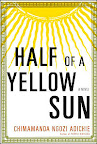 I hardly know where to start writing about

Manon's days of idle leisure are interrupted both by her mother's illness and a slave revolt, Sarah's escape, and the subsequent effort to track her down and return her to Manon. These events provide some movement and force to the plot. The novel provides an unusual perspective -- that of a woman slaveowner -- and it definitely held my interest. However, in presenting Manon's story, the author appeared to maintain a rather neutral position on slavery. It seemed I was supposed to side with Manon in wishing for Sarah's return, when I wanted nothing more than for Sarah to find freedom. I believe this was an accurate portrayal of a certain type of individual during that time period, but I was unable to identify with her, which dampened my enthusiasm for this novel. (