Showing posts with label Booker Prize. Show all posts

Laura's Review - The White Tiger

The White Tiger
Aravind Adiga
276 pages

See, this country, in its days of greatness, when it was the richest nation on earth, was like a zoo. A clean, well kept, orderly zoo. Everyone in his place, everyone happy. ... And then, thanks to all those politicians in Delhi, on the fifteenth of August, 1947 -- the day the British left -- the cages had been left open; and the animals had attacked and ripped each other apart and jungle law replaced zoo law. Those that were the most ferocious, the hungriest, had eaten everyone else up, and grown big bellies. (p. 53-54)


Balram Halwai lives in "the jungle" that is 21st century India. The book is organized as a lengthy letter from Balram to China's Premier, shortly before the Premier's visit to Bangalore. In the letter, written over several days, Balram describes how he left his rural village to work as a driver for the son of the village's wealthiest man. He landed this position completely by luck, and used it to rise up in Indian servant society, and eventually become an entrepreneur.

But this is no rags-to-riches story. It is instead a sometimes humorous, sometimes scathing account of contemporary Indian society. Adiga vividly describes the stark contrasts between "haves" and "have nots," and is resigned to this remaining as status quo for years to come:
An Indian revolution? No, sir. It won't happen. People in this country are still waiting for the war of their freedom to come from somewhere else -- from the jungles, from the mountains, from China, from Pakistan. That will never happen. (p. 261)

The White Tiger explores many of the same themes as A Fine Balance, but I found the latter better-written and far more moving. This was an OK read, but disappointing compared to other Booker Prize winners. ( )

My original review can be found here.

Laura's Review - Schindler's Ark

Schindler's Ark
Thomas Keneally
428 pages

Oskar Schindler was a German industrialist who saved thousands of Jewish people from death in World War II Poland. His story is well known, thanks to the film adaptation of this book. The book is a realistic, factual, stark portrayal of real human drama. Keneally portrays Oskar as a compassionate savior, but not a saint. He was a womanizer and a heavy drinker. After witnessing violence in a Polish ghetto, he was moved to establish a camp on the premises of his factory, with better conditions for his workers. Still, his workers were not immune to the random acts of violence and murder. During the last year or so of the war, through deft negotiation and subterfuge, he managed to transport thousands of Jews to safety, ensuring their liberation when the war came to an end.

Even though I've read several books about the holocaust, I've been able to distance myself from the reality -- not denying these events occurred, but not facing the brutality, either. This book was different. I'm sure my mind was not as graphic as the film, and I unconsciously protected myself from the worst of it, but I still had to take frequent breaks. There were so many individual, heartbreaking stories; I found myself wondering how it could be classified as fiction. The author's note reads,
"To use the texture and devices of a novel to tell a true story is a course which has frequently been followed in modern writing. It is the one I have chosen to follow here; both because the craft of the novelist is the only craft to which I can lay claim, and because the novel's techniques seem suited for a character of such ambiguity and magnitude as Oskar. I have attempted to avoid all fiction, though, since fiction would debase the record, and to distinguish between the reality and myths which are likely to attach themselves to a man of Oskar's stature. Sometimes it has been necessary to attempt to reconstruct conversations of which Oskar and others have left only the briefest record. But most exchanges and conversations, and all events, are based on the detailed recollections of the Schindlerjuden (Schindler Jews), of Schindler himself, and of other witnesses to Oskar's acts of outrageous rescue. "
Seems like nonfiction to me ...

I suspect this book won the Booker Prize more on the basis of Schindler's story; the writing itself was not as fine as I'd hoped. And Keneally was rather repetitive regarding Schindler's appetite for women and alcohol. Was he portraying him as "merely human," or admiring him? I found it tiresome, so a book I would normally have rated 4 stars ended up with only 3. ( )

My original review can be found here.

The Inheritance of Loss - Kiran Desai

The 2006 Booker Prize winner set in the foothills of the Himalayas and part of the time in New York. We follow Sai the orphaned gradaughter of the judge she lives with. He treated his wife terribly and disowned his daughter, but his one love is dog Mutt who he completely spoils. Living with them also is Cook whose son Biju has been sent to New York to find a better life.

Sai has fallen in love with her maths tutor Gyan and he feels the same until their world is shaken up by the Nepalese community uprising. Gyan is Nepalese and is torn between his love and his loyalties. In New York Biju is struggling to make his own way as an illegal immigrant. Back home all anyone wants to do is get to the West where everything is better, they can make more money and get ahead in life. Sadly things are very different from the perception and Biju has some terrible experiences living in a cramped basement and changing jobs often to avoid being caught out.

To be honest I don't have too much to say about this. I enjoyed the style of writing, but I wasn't really taken with the story. I wasn't too involved with the characters except the charming Mutt and I spent most of the book hoping nothing bad would happen to her. Desai was the youngest woman to win the Booker Prize, but I am not sure I would make the effort to read more of her novels in the future.

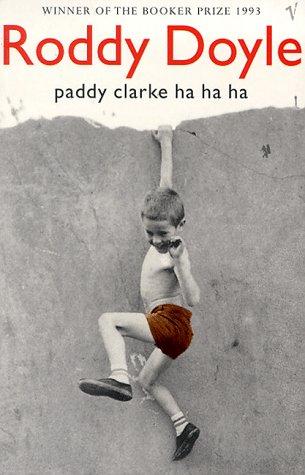
Paddy Clarke Ha Ha Ha - J's Review

Paddy Clarke Ha Ha Ha

Paddy Clarke Ha Ha Ha is the story of a ten-year-old Irish boy in 1968. The book is told in Paddy's voice, and Roddy Doyle captures the confusion and attempts to make sense of the world that go along with being 10, suppositions and extrapolations that children make. Paddy on death and religion:

When Indians died - Red ones - they went to the happy hunting ground. Vikings went to Valhalla when they died or they got killed. We went to heaven, unless we went to hell. You went to hell if you had a mortal sin on your soul when you died, even if you were on your way to confession when the lorry hit you. Before you got into heaven you usually had to go to Purgatory for a bit, to get rid of the sins on your soul, usually for a few million years. Purgatory was like hell but it didn't go on forever.


It was about a million years for every venial sin, depending on the sin and if you'd done it before and promised that you wouldn't do it again. Telling lies to your parents, cursing, taking the Lord's name in vain - they were all a million years.
-Jesus
-A million
-Jesus
-Two million
-Jesus
-Three million
-Jesus

Robbing stuff out of shops was worse: magazines were more serious than sweets. Four million years for Football Monthly, two million for Goal and Football Weekly. If you made a good confession right before you died you didn't have to go to Purgatory at all; you went straight up to heaven.


Most of the book is little bits like this, short vignettes about Paddy's adventures with his friends. Paddy's perspective seems spot on to me, though I've never been a small boy.

Interspersed amongst Paddy's adventures and fights is a more serious story line, that of the crumbling marriage of his parents. They fight, increasingly often, increasingly loudly. At the beginning of the book, Paddy's little brother, Sinbad, is able to pretend that there's nothing wrong, but by the end, there's no pretending anymore. In my mind, the section of the book that is dedicated to this storyline was stronger than the somewhat rambling nature of the rest.

But it took two to tango. He must have had his reasons. Sometimes Da didn't need reasons; he had his mood already. But not all the time. Usually he was fair, and he listened when we were in trouble. He listened to me more than Sinbad. There must have been a reason why he hated Ma. There must have been something wrong with her, at least one thing. I couldn't see it. I wanted to. I wanted to understand. I wanted to be on both sides. He was my da.


The poignancy and sadness of this last section made the rest of the book worthwhile to me. Getting into Paddy's head first did help to give weight and depth to the more serious part. But I will admit that I had some trouble getting through the majority of the book, because I kept waiting for something to happen beyond random tellings of steeplechases through the neighborhood and kids beating each other up.

Amsterdam by Ian McEwan

Amsterdam
Ian McEwan

There are writers whose stories you forget after you put the book down. Or let's say you enjoy a novel and consider it one of the best reads of the year and yet a few months after that you can barely recall the intricacies of plot or the manner of writing, only the feeling that at the time you turn in the page you were smiling like crazy. Then there are writers whose stories haunt you after turning the last few pages of the book. And not just that, the story nestles in your brain and much as you want to expunge it (oh gee, such a strong word) you can't. You feel like you lived in the story. You know the characters or rather you thought you know the characters and yet the author expertly tricks you to his chosen reality.

I've read Amsterdam at least a couple of weeks ago. I still can't get over it. Let's see why.

There are three ex-lovers of the now-deceased but very much married Molly Lane attending her funeral. One, Julian Garmony, is a politician with high hopes of becoming a Prime Minister in the near future. The other two are friends Clive Linley and Vernon Halliday. Clive is a musician, a composer selected to present his latest masterpiece in a program at the turn of the century. Vernon is the editor of a newsmagazine with a steadily declining readership. All three shared a past with Molly at different times in her short life but she married a rich publisher named George Lane.

After the funeral George contacted Vernon and showed compromising photos of Julian Garmony taken by Molly. Considering Julian's promising political career and the fact that his politics isn't well-liked, Vernon pursued to have the photos published, something that Clive didn't like as he takes it as an affront to the memory of Molly. The rest of the story details the events of Vernon's pursuit, of Clive's struggle to compose music, of Julian's composure in public on the imminent publication of the photos and eventually, of an ending that in part was expected by me and yet the real ending (so to speak) particularly the last paragraph or so was a complete and total surprise it pulled the rug off my feet. Because in that last few sentences of the book you think you know what the story is all about and yet, alas, you're completely off the mark. And once you accept it as that you realized that you've been taken for a ride and you very well understand the reasons why. Irony is a good weapon of choice indeed.

On another layer it is a story of friendship. Molly Lane died of a debilitating disease with such swiftness that the two old friends thinking of a future filled with the pain and suffering similar to Molly's promised each other that they'd help each other end it all if and when necessary. It's the kind of friendship forged in years of companionship, a friendship that never doubts until now, when Molly is dead is everything is not as it should be.

To me it's another delicate handling of a story that could've gone completely wrong in another writer's hands. And McEwan is a masterful storyteller capable of fine-tuning the characters until the feel so real to the point you wish you could wring their necks or scream at them, somewhat.

While the politics can be treated simply as such and the portrayal of news hounds as is, I loved the way McEwan managed to make composing music read like you're listening to it. Well, maybe that's just me. I'm tone deaf and I couldn't sing to save my life (gee, I've been using that phrase a lot lately) but I love listening to music. I love separating different instruments in my mind. I love shielding other sounds and retaining just the melody one time, just the guitars another. Again, it's just me. And McEwan captures composing music in a manner that is understandable to someone like me.

I've read four McEwan stories so far, all four different and yet all managing to disturb me one way or another. Disturb in a good sense, that is. I'm sure to read his other novels and he's elevated now to the ranks of writers I'd follow to death. Or something to that effect.

Not very many people share my adoration of McEwan or this book but to me it's always a case of hmmm, what works for me uh, works for me. Right?

-----
Amsterdam won the Man Booker Prize of 1998.

Laura's Review - The Conservationist

The Conservationist
Nadine Gordimer
267 pages

The Conservationist is an in-depth character study of Mehring, a South African businessman-cum-farmer. His success in industry provided the means to buy a 400-acre farm, which serves primarily as a tax write-off. In his quest for material success, Mehring has lost his wife and a mistress. His teenage son attends school some distance away, and has become increasingly independent -- estranged, perhaps -- from his father. Mehring mistakenly views interaction with the black laborers on his farm as a meaningful relationship. In reality, the South African class structure ensures their relationship remains distant.

I found Mehring to be a fairly despicable and pathetic character, which I believe was Gordimer's intent. He is a philanderer, at one point fondling a young lady he'd never met for the better part of a long-haul flight. Yech. And while at times he seems to appreciate the natural beauty of his farm, he has no one to share it with him. His time spent at the farm is empty, a way to pass the weekend or to hide from social obligations.

This was a difficult book to read because the main character was so unlikeable, and it revolved much more around character than plot. However, Gordimer writes some pretty amazing, descriptive prose that brought the South African scenery to life. Despite my rather lukewarm reaction to this particular novel, I will definitely be reading more of her work. ( )

My original review can be found here.

The Gathering - J's Review


Two years ago, I had a letter from Earnest. He was writing to tell me that he was leaving the priesthood, though he had decided to stay with his little school in the high mountains....'I have no place left to live but in my own heart,' he wrote, meaning he would conduct his life as before, but on privately different terms.

And I thought this was the stupidest stuff I had ever heard until, sitting on a stool in the Shelbourne bar, I wondered what might happen if I just carried on as usual, told no one, changed nothing, and decided not to be married after all.

And I wondered how many people around me are living with and sleeping with and laughing with their spouses on just this basis, and I wondered how sad they were. Not very, by the looks of it. Not sad at all.
The Gathering, by Anne Enright, is the story of Veronica, and her coming to terms with the suicide of her favorite brother, Liam. It is her unenviable task to travel from Ireland to England to recover his body, and bring it home for the funeral.

Veronica is falling apart following her brother's death. In addition to her grief, she harbors a secret, or at least, she thinks she does. She is hazy on her memory of an incident during their childhood, and fears that perhaps it may have been the first step toward Liam's eventual death. Her struggle with this memory, with trying to remember what did and what did not happen, and to whom, unravels her happiness and further strains her marriage. You get the feeling that she has never been a joyous person, she is too cold and critical for that, but she did have love and happiness, which are currently overwhelmed by her sadness and her memories. She is a woman in the process of falling apart.

Veronica tells the story of her family, going back to the day her grandparents first met, coming forward to her mother's passive life, and then to that of her many brothers and sisters. She harbors both love and disdain for her mother, whose 17 pregnancies, resulting in 12 children and 5 painful miscarriages, Veronica sees as proof of her mother being unwilling to refuse her father's carnal desires. That her mother might have shared these desires never seems to cross her mind.

Already a cold person, Veronica shuts down emotionally in the period following her brother's death. She resents her husband for wanting sex so soon after the death, resents him trying to prove to her that she is still alive. After that first encounter, she refuses to come to bed any more, instead staying awake all night, every night, drinking wine and waiting for him to get up for work before she herself collapses into bed.

The title of the book, The Gathering, made me think this was going to be the story of a family coming together, and of the joys and recriminations that might come to light at such a gathering. But at least 3/4 of the book is told in her meandering way, as she travels through memories and stories, while on the way to and from England on her sad task. Only at the end do we meet her siblings, and find ourselves at a surprisingly muted event.

If I were to read this review up until this point, I would think that The Gathering isn't really worth reading, and that Veronica is a character that I would not like. But Enright's writing is so beautiful, and she is able to bring you into Veronica's mind so well that you feel sympathy for her, for what she's been through, for her upbringing. You hope for her to find peace with her family again, and joy within her marriage. The end is too ambiguous for that, and I walked away feeling someone dissatisfied.

I have seen The Gathering compared to The Dubliners, by James Joyce. One big difference is that The Gathering is a novel, while The Dubliners is a book of short stories. I've only read the most famous story in that book, The Dead, which is a story that touched me very deeply. The Gathering is similar in its prose and imagery, and in that the book seems to meander along until finally you get to the end, and it turns out that the end is what you were waiting for all along. In The Dead, however, that end is a beautiful respite, and a glimpse into love that is not jealous or unkind, despite the jealousy and unkind thoughts that were there moments before...a love that transcends this mortal world, however mortal the players. The Gathering offers no such great reward.

I would recommend this book to people who love beautiful, evocative writing. Enright is a gifted writer in this aspect. I would not recommend this book for anyone seeking an easy, quick read, as the twists and turns and dark subject matter make this a somewhat difficult read.

Possession

This 1990 Booker Prize winner was second only to LOTR on the poll of what books I should take. It seemed to be popular with the visitors and I can understand why. I read this during my unfortunate delay before departure. It was absorbing and while a bit lengthy at over 500 paperback pages, enjoyable. It is complex, literary, stylistically varied, and meta. There are various writing styles employed from poetry, critical academia, memoir writing, fairytales, to epistolary writing. While I found the ending just a tad too maudlin and the modern characters Maud and Roland not as well drawn out as Ash and Christabel, I liked the book overall. Byatt obviously took care in tracing the mystery aspect, and it is certainly not a conventional romance (or romances). It has many themes and interesting implements. It has academics writing not about poets, but also other academics. There's a definite sense of meta literary and commentary beneath the surface. The idea of not only romantic possession, but that which possesses us from the long gone writers. It reminds me of Shakespeare academia and the sheer obsession academics have about him whoever he may be. Just a little thing could just how history views people and how we are enthralled, or "possessed" with the dead and ideas from and of them. I am glad to own this novel as I find that it will be immensely rereadable.

Crossposted from aquatique.net

J's Review: Posession: A Romance

Maud shivered, as she always shivered, on reading this document. What had Christabel thought, when she read it? Where had Christabel been, and why had she gone, and where had Randolph Ash been, between July 1859 and the summer of 1860? There was no record, Roland said, of Ash not being at home. He had published nothing during 1860 and had written few letters - those there were, were dated from Bloomsbury, as usual. LaMotte scholars had never found any satisfactory explanation for Christabel's apparent absence at the time of Blanche's death, and had worked on the supposition of a quarrel between the two women. This quarrel now looked quite different, Maude thought, without becoming clearer.
I finally finished reading Possession: A Romance, by A.S. Byatt. I'm sorry to say that I never felt truly drawn into the story. It reminded me of something my mom once said when I was working on my Masters Degree in Comparative Literature. She said, "I'm not a huge fan of 'capital L Literature'. What I want to read is a good story." Not that the two are mutually exclusive, and I would argue that the best of 'capital L Literature' is great because of the story, not because of the genius of the author. Reading Possession, I never got sucked in, I was always waiting for the story to have some passion, some caring for the characters, some real drama. I found it had tenderness toward its characters, and there is real skill in the way that Byatt interweaves diaries, letters, and narrative to tell her story. But again, I couldn't make myself care about any of it.

The book starts with a young, frustrated academic, Roland Michell, doing some research on his subject, (fictional) Victorian poet Randolph Ash. He comes across some unfinished letters in Ash's handwriting, tucked amongst the pages of a book in the library. Impulsively, he tucks the letters into his wallet, rather than alerting the librarian of their existence, or at least tucking them back where they belong. The letters appear to be to a woman that Ash has just met, and feels a connection to. He wants to see more of her. But who is she? Scholarship on Ash is that he was a faithful husband, happily married to the same woman for over 40 years. Roland asks around, and ends up entering into a partnership with Maud Bailey, a scholar who studies the life and works of a contemporary of Ash, Christabel LaMotte, the woman for whom Ash's letter was meant.

Roland and Maud go on a search for the truth, which they are hiding from their contemporaries in LaMotte and Ash studies, hoping to be the ones to break the story to the academic world, which would be a huge feather in their caps, and a great help in their careers as well. The rest of the book travels between their story and that of LaMotte and Ash, which is told mainly through their letters to one another, through their respective poems, and through diaries written by Ash's wife and LaMotte's cousin. It's intriguing enough, with plenty of twists and turns and surprises to keep the reader interested. Unfortunately, for me, Byatt kept her characters at an emotional distance, so while I was slightly interested in finding out what had happened between these Victorian poets 150 years ago, I sort of resented the amount of time and effort that I had to put into the discovery.

Last Orders

This Booker Prize winning book by Graham Swift tells of four men on a day trip to scatter their friend's ashes to the sea. The chapters are short and the narratives switches with each chapter. Most are told by Ray, the closest friend of the dead man Jack Dodds. There are numerous flashbacks revealing the lives of all the men and a couple of others in their lives. The dialogue is quite sharp and well written; Swift has a knack for characterisation. The language and changing perspectives makes it evocative. I sometimes managed to feel the bitterness and the anger that some of the characters do when they narrate. It is very English; all the characters have a working class background and there is something very stylistic and true about the way he writes about their livelihood. If anything, it feels sincere even if real working class Londoners do not all the issues these characters did. I liked the book for the most part, but it got bit depressing the further you went. The flashbacks reveal missed opportunities, unsaid things, wrong choices, bad luck, and estranged relationships. The ending, as with life, is open ended. Not a very uplifting read, but Swift does have a good voice throughout the story.

For a review of the film as well, go to aquatique.net.

The God of Small Things - Arundhati Roy

The story mostly focuses around dizygotic (from two eggs) twins Estha and Rahel who have no last name due to their mother being undecided at the time whether she would use their fathers name or her fathers name. It is set in India mostly and follows their family members when their white cousin Sophie Mol comes to visit them (the three are children at the time) and their uncle, her biological father. She is found drowned in the river after only being with them for a couple of weeks.

The story jumps around quite a lot in time narrating the events leading up to Sophie's arrival, later death and the far reaching consequences over twenty years later for the twins and their family. The storytelling reminded me in style of Margaret Atwood and Salman Rushdie's Midnights Children in the way it wasn't a linear tale and the way the characters were developed. The book it most brought to mind was One Hundred Years of Solitude by Gabriel Garcia Marquez.

It tells of love, who you can love, how much and in what way. A strange novel which I can't work out if I enjoyed or not. The final short chapter was beautiful concerning the twins mother, but I didn't like how Roy left the story of the twins. In places it was quite a slow and difficult read, but some of the language really stayed with me. I think this one needs some time dwelling on it before I can properly move on.

The Blind Assassin - Margaret Atwood

The story of Iris Chase and her younger sister Laura as told by Iris aged 83 along with a selection of newspaper clippings. Brought up at the beginning of the last century into a wealthy family in Canada, Iris is charged by her parents and housekeeper Reenie to take care of Laura who can be very literal about life. When their family starts heavily loosing money, their father's button factory is set alight and Laura's communist friend Alex Thomas is blamed. The girls hide him until he is able to escape and he is never forgotten by either girl.

Iris marries prominent businessman Richard Griffin in a bid to save her fathers business against her wishes aged 18. Him and his poisonous sister Winifred soon take over both hers and Laura's lives using them as pawns in their own games in their political endeavours. There are sections amidst the main storyline with two unnamed lovers who are meeting in secret. The man tells the woman a wonderful series of stories he makes up, my favourites were following the blind assassin and the girl from the temple.

It is typical Atwood storytelling with the plot jumping around from the present, to the past, to newspaper articles which tell you the end of the main story before you hear about how they all get there plus the unnamed lovers. There were some great twists and revelations at the end, and I didn't see all of them coming which is always good. It took a little longer than usual to really grab my attention, but I loved it once I started to get to know the characters more. That is Atwood's strength, her development of her characters especially the female ones.

Laura's Review - The Gathering


The Gathering
Anne Enright
261 pages

"There is something wonderful about a death, how everything shuts down, and all the ways you thought you were vital are not even vaguely important. Your husband can feed the kids, he can work the new oven, he can find the sausages in the fridge, after all." (p. 27)

The Gathering is an intimate and painful look at grief. Veronica Hegarty's life has been turned upside-down by her brother Liam's suicide. Throughout this novel Veronica operates in a fog, disconnected from her siblings, her husband, and her children. She is barely able to function. As she reflects on her brother's life, she tries to piece together elements of their shared past, but her childhood memories are fraught with inaccuracies and inconsistencies. Liam's death also makes her keenly aware of her own less-than-satisfying adult life: "I was living my life in inverted commas. I could pick up my keys and go 'home' where I could 'have sex' with my 'husband' just like lots of other people did. This is what I had been doing for years. And I didn't seem to mind the inverted commas, or even notice that I was living in them, until my brother died." (p. 181) When did it all go wrong?

As winner of the 2007 Booker Prize, The Gathering has received more than its share of reviews. It seems to be a "love it or hate it" book, mostly because it is so bleak. This is, indeed, a very sad book. Each person seems to be lost in their own island of grief, unable to support one another. Veronica withdraws completely; her siblings are each caught up in their own childhood baggage and destructive behavior patterns. As the book draws to a close, the truth has proven to be elusive, and the future is uncertain. Those looking for neat and tidy endings will be disappointed, but I found The Gathering's stark realism to be both intense and memorable. ( )

My original review can be found here.

Laura's Review - The Bone People


The Bone People
Keri Hulme
445 pages


"A family can be the bane of one's existence. A family can also be most of the meaning of one's existence. I don't know whether my family is bane or meaning, but they have surely gone away and left a large hole in my heart." (p. 242)

Keri Hulme's Booker prize-winning novel is about the healing power of relationships and family bonds. Kerewin is an artist and recluse, unmarried and estranged from her family. Joe is a widowed laborer with a violent temper. Simon, Joe's foster son, lost his parents in a boating accident. Simon's specific identity is unknown, he cannot speak, and he has suffered severe emotional trauma. These three very lonely people come together when Simon breaks into Kerewin's house. Slowly, tentatively, Joe and Simon reach out to Kerewin. Slowly, tentatively, she accepts their attentions. After a long holiday at a seaside camp they are as close to a family as any of them have ever experienced. However, the dark side of each character looms large, and when the inevitable happens each character is shaken to their very core and must choose when and how to begin the healing process.

Hulme's writing style is unorthodox, yet I found this book difficult to put down. I was completely committed to the characters, despite their often significant flaws. The insights into Maori culture were interesting. Although I was a bit uncertain how the ending came together the way it did, I very much enjoyed the journey. ( )

My original review can be found here.

"Midnight’s Children" by Salman Rushdie

Saleem Sinai, our narrator, was born on August 15th, 1947, just as the clocks stroke midnight. This is the exact moment of India’s arrival to independence, and he, along with all the other children born between midnight and one in the morning that day, has extraordinary powers. Some of the Midnight Children can fly, others can change their sex at will, others have the power of true sorcery, and yet know the secrets of alchemy. Some dazzle others with their superhuman beauty; others can travel in time or multiply fishes. Saleem’s gift is the most powerful of them all: he can see into the hearts and minds of men.

Saleem tells the story of his life – which is also the story of his true-twin, India – to his lover Padma. The story begins thirty years before he is born, when his grandfather returns to India after studying medicine in Germany and meets his grandmother in a very original way. The first section of the book is devoted to the lives of Saleem’s family before his birth. In the second and third sections, Saleem’s childhood and early adulthood are intertwined with the life of the newborn country: the formation of India and Pakistan and his birth, the war between India and China and the marital problems of his parents, the tumultuous relationship between Pakistan and India, which eventually led to war, and his exile, the emergence of Bangladesh and Saleem’s experience with death and loss, Indira Gandhi and the state of Emergency and his downfall.

I really liked the Arabian Nights-esque device of having the story being told by the narrator to his lover. The writing style is very much reminiscent of oral tales, and Padma’s interruptions are interesting and colourful. There aren’t all that many authors that can pull off that sort of rambly storytelling style successfully, but Salman Rushdie is no doubt one of them.

I have to say that I have somewhat mixed feelings about the term "magic realism". It seems to me that sometimes it is used as an attempt to, to paraphrase Terry Pratchett, give Fantasy a bath, dress it up in a suit and tie, and take it to a cocktail party to be introduced to Respectable People. Take a look at this wikipedia definition, for example: magic realism (or magical realism) is an artistic genre in which magical elements or illogical scenarios appear in an otherwise realistic or even "normal" setting. This is not very helpful as far as definitions go, because the exact same thing could be said of urban fantasy. This definition would only successfully distinguish magic realism and fantasy if we exclusively considered alternative world fantasy, but that would be a very narrow, and thus misleading, definition of fantasy.

But on the other hand, there is a very specific storytelling mode that I find in the works of Gabriel Garcia Marquez, Daniel Wallace, Jonathan Safran Foer to an extent, and Salman Rushdie, and magic realism is as good a term as any to describe it. As I was reading Midnight’s Children, I asked myself: what is it exactly that makes this storytelling mode so distinctive? The answer that I came up with may not be entirely adequate, but here it goes anyway: for me, in a book like Midnight’s Children, suspension of disbelief works differently. It is a book in which, like in a fantasy, we are told things that go beyond the boundaries of the real. But, unlike in a fantasy, we do not necessarily take them at face value. We do not necessarily trust the teller of the tale (of course that there can also be fantasies in which this is also the case, but bear with me). We go along with the story, yes, but there is a subtle understanding that, in the world of the story itself, the extraordinary events are perhaps metaphorical, are maybe a way to convey a mood or a feeling that could not otherwise be conveyed. Saleem is a narrator that constantly challenges the reader’s faith in his accuracy. For example:
“…But now Padma says, mildly, ‘What date was it?’ And, without thinking, I answer: ‘Some time in the Spring.’ And then it occurs to me that I have made another error – that the election of 1957 took place before, and not after, my tenth birthday; but although I have racked my brains, my memory refuses, stubbornly, to alter the sequence of events. This is worrying. I don’t know what’s gone wrong.
She says, trying uselessly to console me: ‘What are you so long for in your face? Everybody forgets some small things, all the time!’
But if small things go, will large things be close behind?”
There are many other instances in which he tells Padma (and the reader) that even though what he is about to tell is unbelievable, they must believe him, and interestingly enough this plea tends to have the opposite effect. It’s not that it boycotts the story, it’s not that it makes it any less engaging, it’s just that it changes the way in which it works. We become more aware that we are witnessing a process that is akin to mythmaking.

Other things I liked about this book: the many references to Hindu mythology even though Saleem’s background is Muslim, the points that were made about freedom and oppression, poverty and inequality, and the dangers of religious extremism, the colourful portray of Bombay and of Indian culture (or cultures) in general. I also loved the way the second part of the book in particular recreated the world of a child so successfully. Saleem grows up in a villa in Bombay, and his description of his own experiences and of the way he, as a child, understands the lives of the adults who surrounded him, plus his discovery of his telepathic powers and his description of his first crush on a girl named Evie Burns, were my favourite parts of the book.

In the third section of the book, the story becomes very overly political, and I saw that Rushie’s harsh portrait of Indira Gandhi and her policies caused some controversy. Some of the things described in the book are pretty horrific, but I have to say that I simply don’t know enough history to judge whether or not Rushie was being too harsh. This book made me want to learn more, though, and that can only be a good thing.

There is much, much more to the book, and I fear that I am not making it justice. It’s just one of those books that encompass innumerable different things. If you got ten people who all agreed that it was a great book in a room and asked them to tell you why, I’m sure they would come up with ten different reasons why they loved it. To sum it up: I found Midnight’s Children an original, engaging and stimulating book, and I would recommend it to anyone with an interest in history, different cultures, myths or simply good stories.

Paddy Clarke Ha Ha Ha - Roddy Doyle


Tells the story of Paddy Clarke (Patrick) growing up in Ireland in the 1960s. Set in the fictional estate Barrytown when Paddy is 10, Doyle looks at childhood and the brutality of it. Paddy is pretty much second in bully Kevin's gang and they get into all kinds of trouble. Probably the worst is pouring lighter fluid down Paddy's younger brother Sinbad's (Francis) mouth and then lighting a match horribly burning his lips. Another time they post a dead guinea pig through the letterbox of a woman in their estate that they don't like.

About halfway through the book it turns from the misadventures of youth to a more serious tone as Paddy's parents marriage begins to reall break down. Paddy begins to take more responsibility in trying ti stop their fighting without their knowledge as well as looking out more for Sinbad who is starting to grow up. He starts to recognise Kevin for the true bully he is and hang out with loner and hard knock Charles Leavy.

The children are written very convincingly, both their language and their often bizarre logic. For instance in fights there are rules and if one hits another you get a free hit in return. It made me miss my childhood a little with all the random games with local kids. It also made me sad as this culture seems to be shrinking as kids these days seem more interested in indoor persuits like watching the television and playing computer games rather than running about and playing outdoors.

Midnight's Children - Salman Rushdie

The tale of Saleem Sinai who is born at midnight on August 15th, 1947 at the precise moment of India's Independence linking his fate forever with his country's. The story begins with Saleem's grandfather and how he met his grandmother and continues until the beginnings of the generation after Saleem. As Saleem was born at midnight, he has been given special powers which he shares with his nemesis born at the same time in the same hospital. The other children born throughout India born in the midnight hour also have powers and they come together to form the Midnight Children's Conference which Saleem hopes will better the world.

The story is epic covering so much history and it becomes even more soas events unfold and small incidences come back to haunt Saleem and lead to much bigger events. It is very hard to review this book without giving much of the plot away so I appologise that this is a little vague. It did take me a little while to get into Rushdie's writing style as it is very disjointed with the narrator (Saleem) skipping forwards and backwards in time often within the same sentence. Once I got into it, I really enjoyed it and loved the language and style. I warmed to many of the characters despite their many flaws which are discussed at length in the story.

Just to give you a little taste of his writing style here are a couple of extracts:

"I was born in the sity of Bombay... once upon a time. No, that won't do, there's no getting away from the date: I was born in Doctor Narlikar's Nursing Home on August 15th, 1947. And the time? The time matters, too. Well then: it was at night. No, it's important to be more... On the stroke of midnight, as a matter of fact. Clock-hands joined palms in respectful greeting as I came. Oh, spell it out, spell it out; at the precise moment of India's arrival at Independence, I tumbled forth into the world."

"No colours except green and black the walls are green the sky is black (there is no roof) the stars are green the Widow is green but her hair is black as black. The Widow sits on a high high chair the chair is green the seat is black the Widow's hair has a centre-parting it is green on the left and on the right black. High as the sky the chair is green the seat is black the Widow's arm is long as death its skin is green the fingernails are long and sharp and black."

I do recommend it if you can get past the first 50-100 pages and I will definitely be reading more by Rushdie in the future. I can see where Zadie Smith gets some of her inspiration after reading this novel.

The Gathering - Wendy's Review

I would like to write down what happened in my grandmother’s house the summer I was eight or nine, but I am not sure if it really did happen. I need to bear witness to an uncertain event. -From The Gathering, page 1-

Anne Enright won the 2007 Booker Prize for this novel set in Dublin which centers around a woman’s long repressed childhood memories. Veronica Hegerty is one of twelve children - a large and dysfunctional family with dark and unspoken secrets. The suicide of Veronica’s wayward brother Liam provides the catalyst for Veronica’s traumatic memories to surface. Told from Veronica’s point of view and switching from past to present and back to past again, the story is a twisting tale about the reliability of long buried events and the importance of uncovering secrets. Veronica’s revelations about what happened in her grandmother’s home so many years in the past are tangled up in alternative stories fabricated by Veronica, woven together with guilt and shame.

Veronica is a cold, cynical person - angry with her mother’s passivity, confused about her brother’s choices, and ambivalent about her siblings.

Meanwhile, the train chunters through England, clicketty-clack, and Bea talks on, sitting on my dead father’s knee with a ribbon in her hair, like the good little girl she has always been, and I look at the hills, trying to grow up, trying to let my father die, ring to let my sister enter her adolescence (never mind menopause). -From The Gathering, page 43-

She is a woman struggling in a rocky marriage which is made more unstable by Veronica’s negative view of men. But, she is not all hardness and anger. Veronica’s love for her children leaps from the pages and as the novel unfolds, the reader is drawn to Veronica, wanting to understand her and make sense of her life.

Enright leaves the reader with ambiguity in the end. The facts are hazy and the outcome of all the characters’ futures are unsure.

The power of this novel comes from Enright’s fresh language and her ability to expose her characters’ faults. Time and again I found myself stunned by the searing choice of words and phrasing; the graphic descriptions; and Enright’s ability to take the reader to an uncomfortable place to drive home her point.

The Gathering is a tough book which deals with a difficult subject matter. Enright seems to purposefully set out to shock the reader - dragging her through the muck of dysfunction and pain, stirring up the sediment in the lives of the characters to reveal their souls. Written with a great deal of intelligence, unerringly true to its characters, and staggering in its scope - The Gathering is a novel which is not easily forgotten.

Highly recommended; rated 4.5/5.

Laura's Review - The Sea, the Sea


The Sea, the Sea
Iris Murdoch
495 pages


Charles Arrowby is a London theatre director who has recently retired to a seaside cottage in the south of England. He plans to write his memoirs, with particular focus on his lover-mentor, a woman named Clement. The book is written in the first person; Charles chronicles both day-to-day living in his cottage, and describes his life and loves. Vanity and jealousy are central themes. Charles spent his life immersed in theatre, entangled in complex relationships. His cousin James grew up in a more privileged environment and was a perennial cause of envy. Hartley was Charles' childhood sweetheart and, having been rejected by her as a young adult, Charles has been unable to deeply love anyone else. He toys with the affections of two actresses, Lizzie and Rosina, and fancies himself as having power over them when in fact, it is exactly the reverse.

The plot thickens when Charles meets up with Hartley, who surprisingly lives in the village near his cottage. She is married, with an adult son. But this does not stop Charles from pursuing her, and trying to re-create the happiness he felt as a teenager. Meanwhile James, Rosina, Lizzie, and others make frequent visits and try to talk sense into Charles. As Mary Kinzie writes in her introduction to the Penguin classic edition, Charles "violently and bullheadedly persists in all the wrong directions." None of his plans work out as he hopes. And as these plans unravel, he keeps trying to find another way to achieve his dreams. A climax of sorts occurs about 100 pages before the end, in which Peregrine, a theatre friend, calls him on his negative and manipulative behaviors: "You're an exploded myth. And you still think you're Genghis Khan! Laissez-moi rire. I can't think why I let you haunt me all these years. ... You never did anything for mankind, you never did anything for anybody except yourself." (p. 395)

Despite these character traits, Charles is not completely despicable. Iris Murdoch had a tremendous talent for portraying the middle-aged to older man and all his foibles, in a way that made the man mostly likeable. The Sea, the Sea also includes some interesting plot threads: Charles' pursuit of Hartley; Hartley's marriage; Hartley's son Titus; Charles' relationship with James, and so on. All in all, a satisfying read. ( )

My original review can be found here.

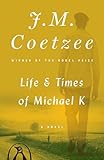
Life and Times of Michael K. by J. M. Coetzee

Set in South Africa, this 1983 Booker Prize Winner by Nobel Laureate (2003) J. M. Coetzee is about a man surviving amidst war, civil unrest, and poverty. There are no chapters, but three sections divide book. The first covers more than 2/3 of the novel. The plot is one of the most depressing I have read in a long time. The prose is stark and observant. Michael K. is a mysterious yet simple character at the same time. The novel makes you ask a lot of questions about the setting, the characters, and the overall meaning and moral of this novel. It was a quick read at 249pages. The writing was bare, but there were some wonderful lines:
I come from a line of children of no end.

Another excerpt:
He is like a stone, a pebble that, having lain around quietly minding its own business since the dawn of time, is now suddenly picked up and tossed randomly from hand to hand. A hard little stone, barely aware of its surroundings, enveloped in itself and it interior life...An unbearing, unborn creature.

There is doubtlessly a lot of criticism and interpretation of this work. There seems to be debates about Michael's race/ethnicity. Is he black or white? There were indications in the book that he goes either way, but Michael himself does not seem to see race. Michael's intelligence or intellectual capabilities are questioned. He does not seem to have much of a sex drive, and his upbringing lacked intimacy or any fun. Finally, the setting is almost dystopian and some critics debate about the actual time of the book. It's hard to say if I liked it or how soon I will pick up another of Coetzee's work again, but it was fascinating read. (Cross posted from my blog Aquatique)