Showing posts with label National Book Award. Show all posts

The House of the Scorpion


Farmer, Nancy. 2002. The House of the Scorpion. Simon & Schuster. 380 pages

In the beginning there were thirty-six of them, thirty-six droplets of life so tiny that Eduardo could see them only under a microscope. He studied them anxiously in the darkened room.

If you haven't read The House of the Scorpion, you really don't know what you're missing. It's as wonderfully complex and beautiful and thrilling as Frankenstein. (Which, if you remember nothing else about me, remember my love for Mary Shelley's monster.) The House of the Scorpion is science fiction. Set several centuries in the future, it revolves around the Alacran family, rulers of the empire of Opium which borders the United States and Mexico. Well, what used to be called Mexico. Our hero, Matteo Alacran, has an unusual upbringing. His first five or six years are almost spent in complete isolation. His only interactions being with his caregiver--not his mother, who was sacrificed--a woman, a servant, named Celia. But one day, in his cabin, he hears voices. He sees two children. A boy and a girl. And despite Celia's warnings, his curiosity gets the better of him. And he springs through the window--the doors and windows being locked--freeing himself, yes, but bloodying himself up in the process. What this teaches him--among other things--is that he is different. Not just a little different, but DIFFERENT. His very existence seems to repulse people. Why? What did he ever do to them? Thus Matt's struggles begin.

The book traces his childhood from birth through age fourteen or so. As I said, it's a unique one. The household being darkly twisted and as dysfunctional as can be. The few friends Matt make cannot ever overcome his great disadvantages. Though small threads of hope remain. Matt's future remains uncertain. And his present is full of dangers as well. Life is not easy, but it's all he knows. His very life depends on the conclusions he will come to draw, the observations he continues to make.

The House of the Scorpion is a thrilling science fiction novel that is intelligent and intense.

Charming Billy - J's Review


Billy Lynch, alcoholic, romantic, kind and loving man, has died. His friends and family come together to comfort his widow, and to celebrate his life. And Billy's life seems to have two stories to it. The sad story of his alcoholism, which his friends and family tried again and again to guide him away from, with no success. And the sad story of his first love, an Irish girl whom he intended to marry, but who goes back to Ireland and dies. At least, that's what Billy is told. The truth is, she took the money he sent her for her passage to America, bought a gas station in Ireland, married someone else, and built a life for herself there.

This cruel twist comes pretty early on in the book, and the rest of the story is the meandering tale of his romance with the Irish girl, his grief at her 'death', his marriage to Maeve and their life together. Her suffering through his alcoholism, her reliance on his cousin, Dennis, to help her when he comes home drunk at 3am, night after night after night.

The story is told by Dennis' daughter, sometimes as told to her by her father, sometimes as though she is telling the story to her husband. I found the point-of-view narration a bit confusing, and somewhat irritating. Sometimes the narration would change within a single paragraph from first to third person. The language is often lovely, and the author captures the way that people talk, the honestly of their voices and grief, their delight in gossip, but desire to protect Maeve from that same gossip. Mostly though, I just wanted to shake Billy and tell him to stop drinking so much, get over his youthful romance, and see if living for today, with the life he has made for himself, might actually be more rewarding than pining away for someone long gone, and trying to drink yourself into an early grave. I wish I had enjoyed this book more than I did. Has anyone else read this book? Agree or disagree with me on my summation? I'd love to hear from someone who loved it, and find out what you got out of it that I missed.

Charming Billy is a National Book Award winner.

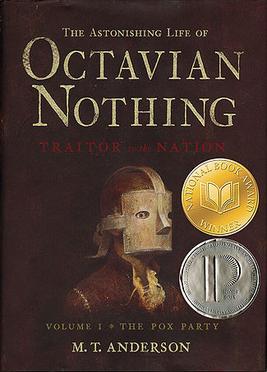
Octavian Nothing


Anderson, M.T. 2006. The Astonishing Life of Octavian Nothing: Traitor to the Nation: Volume 1: The Pox Party.

Let's see...what can I say about Octavian Nothing. It's an award-winning book--winner of the National Book Award, winner of a Printz Honor. It's historical fiction--set in the Colonies right before the American Revolution. It's more literary than your typical teen book--it's heavy in semicolons and rich in detail.

So what is so astonishing about the life of Octavian Nothing? Many things. Many many things. For starters, he's a slave who doesn't quite realize he's a slave. He has little inkling just what he is...or who he is. Who is he? He's a human experiment. He's being studied to determine if Africans are inferior (or equal to) to Europeans. Everything about him is being observed and measured. He's been given the finest clothes, housed in a luxurious way (at least comparatively speaking), taught to play musical instruments, taught in a classical way--learned in many diverse subjects including English, French, Greek, and Latin. He is a child who had a very strange, very odd, very out-there upbringing. Who is raising him the members of the College of Lucidity. Strange men who are fascinated by science, math, philosophy, art, music, etc.

There are several events that change everything for Octavian. That turn his whole world, his whole life, his very being upside down and inside out. Through the course of the book, Octavian goes from a privileged boy who is clueless about the oppression of slavery to a full-grown man who has experienced the oppressive wrath and cruelty of his masters. A man who now longs for freedom.

Even that isn't quite a fair assessment of what this book is about...of what it has to offer readers.

I can't promise you that you'll love it...or even like it. You may, of course, respond that way. But this is a book that requires you to be engaged, to connect emotionally and intellectually with the text. It's a book that requires you to wear your thinking cap.

It's a book that I'd love to use for my Reading With Becky google group. I haven't gotten any response from that group yet whether they'd be interested. But I *do* hope that I can sway some to read it. If you're interested in reading this as a group, come and join the group (email me at my google address blaney1129ATgmail.com)...let's make this happen :)

© Becky Laney of Becky's Book Reviews

The Penderwicks


Birdsall, Jeanne. 2005. The Penderwicks: A Summer Tale of Four Sisters, Two Rabbits, and a Very Interesting Boy.

For a long time after that summer, the four Penderwick sisters still talked of Arundel. Fate drove us there, Jane would say. No, it was the greedy landlord who sold our vacation house on Cape Cod, someone else would say, probably Skye.

I liked this one. A lot. It was a nice and enjoyable novel. One that a whole family could enjoy. One that was meant to be read aloud and shared. It's not a loud story. Not crammed with action and explosions and bathroom jokes. But it's a good and pleasant one. It's a story of the Penderwick family--Mr. Penderwick, Rosalind (12), Skye (11), Jane (10), and Batty (4), and their dog, Hound. Mrs. Penderwick died when Batty was just a baby. (From cancer I believe.)

The book is about one of their summers. The summer that they visit Arundel, a cottage. It is owned by a rather grumpy and snooty woman Mrs. Tifton. But Mrs. Tifton has a son, Jeffrey, and a gardener, Cagney, and there is where the fun begins. New friends to make. Problems to create and solve. Life to be experienced.

Recommended for those who like a bit of old-fashioned charm in their lives.

About the book:

The Penderwicks: A Summer Tale of Four Sisters, Two Rabbits, and a Very Interesting Boy is on many State Award Master Lists, including those for Arizona, Hawaii, Illinois, Kansas, Kentucky, Maine, Massachusetts, Michigan, Nebraska, New Hampshire, New Mexico, Pennsylvania, Rhode Island, South Carolina, Tennessee, Texas, Vermont, and Virginia. Other awards and honors include:

  • National Book Award Winner for Young People’s Literature
  • New York Times Bestseller
  • Book Sense National Bestseller
  • Booklist Editors’ Choice
  • Kirkus Reviews Editors’ Choice
  • Publishers Weekly Best Children’s Book
  • School Library Journal Best Book of the Year
  • Child Magazine Best Kids’ Book of the Year
  • Children’s Book Sense Top Ten Pick
  • 2007 Kalbacher Klapperschlange (Germany)

© Becky Laney of Becky's Book Reviews

The Year of Magical Thinking by Joan Didion

The Year of Magical Thinking
Joan Didion

I've read this book sometime last year. I have to admit it took a long time for me to read for personal reasons. For one thing it was a book given by a friend a couple or so weeks after my mom passed on. I tried reading it a couple of months after the fact and gave up. Then there's the part where I can't seem to read anymore because my eyes almost always fill with tears and I just had to close the book and think happy thoughts. Ok, that didn't sound right.

But the initial difficulty passed as did time. Maybe sadness and grief work that way. Maybe I was still in denial, in my own state of magical thinking. When I picked the book up again last year, more than a year after I received it in the mail, I was ready. Still hurting but ready nonetheless.

Didion's book is an account of the twelve-month period after her husband, John Dunne, died of a massive heart attack. At the time of his death their daughter, Quintana Roo, was sick and admitted to another hospital for septic shock. And while the book covers the process of grieving, it basically embraces the power of marriage and family, and eventually the notions of the one left behind, as in this case the widow Joan.
This is my attempt to make sense of the period that followed, weeks and then months that ut loose any fixed idea I had ever had about death, about illness, about probability and luck, about good fortune and bad, about marriage and children and memory, about grief, about the ways in which people do and do not deal with the fact that life ends, about the shallowness of sanity, about life itself.

There is clarity in her perceptions that those who have lost someone can relate with. Maybe that's why I cried while reading. Or at times I just had to stop.
Grief is different. Grief has no distance. Grief comes in waves, paroxysms, sudden apprehensions that weaken the knees and blind the eyes and obliterate the dailiness of life.

And while there is clarity, there is also a sense of repetition which is understandable. This is magical thinking after all.
Survivors look back and see omens, messages they missed.

They remember the tree that died, the gull that splattered onto the hood of the car.

They live by symbols. They read meaning into the barrage of spam on the unused computer, the delete key that stops working, the imagined abandonment in the decision to replace it. The voice in my answering machine is still John's. The fact that it was his in the first place was arbitrary, having to do with who was around on the day the answering machine last needed programming, but if I need to retape it now I would do so with a sense of betrayal.

Didion gives a voice or an echo of what's it like to lose someone. A voice for those of us who can't find it yet, for those who stammer and mumble incoherently, for those who want to get out of that state of denial because there is plenty here, and plenty more room for thoughts of moving on and remembering well.

But for others whose grief are unfathomable, this is just an echo because theirs that can never be defined. They can never be assuaged by thoughts that others have felt that same hollow feeling inside. And I can understand that.

It took me more than a year to finally read the book and a handful of months to finally post about it. I'm just glad I did both: read and finally post about it.

-----
This is technically speaking the second (or third) book I read (I'm not really sure) for the Book Awards Reading Challenge but obviously I only posted about it now. But this would count as my eleventh book in all. The Year of Magical Thinking won the National Book Award in 2005 for nonfiction.

Invisible Man by Ralph Ellison

Synopsis from Barnes & Noble:

"Ralph Elllison's Invisible Man is a monumental novel, one that can well be called an epic of modern American Negro life. It is a strange story, in which many extraordinary things happen, some of them shocking and brutal, some of them pitiful and touching—yet always with elements of comedy and irony and burlesque that appear in unexpected places. It is a book that has a great deal to say and which is destined to have a great deal said about it.

After a brief prologue, the story begins with a terrifying experience of the hero's high school days, moves quickly to the campus of a Southern Negro college and then to New York's Harlem, where most of the action takes place. The many people that the hero meets in the course of his wanderings are remarkably various, complex and significant. With them he becomes involved in an amazing series of adventures, in which he is sometimes befriended but more often deceived and betrayed—as much by himself and his own illusions as by the duplicity of the blindness of others."

This novel has received praise from all quarters ever since its original publication, and in my opinion every bit of praise is well-deserved. This is a magnificent book. Mr. Ellison is able to make you connect with the main character in a way that few authors can. It's not an easy read, but then I'm sure it wasn't meant to be. And by not easy, I don't mean the writing style -- the book flows and moves incredibly quickly -- but rather the subject matter. Often, an author can only shake us out of our comfort zone by showing us how brutal and ugly life can truly be. And there's no doubt that, no matter how advanced and "civilized" our society is, there continues to be discrimination of all types. As a white woman, I'm sure that I will never truly understand what it feels like to be a minority in our society, but this book moved me just a little bit closer and for that, Mr. Ellison deserves and receives my gratitude.

Review: In the Heart of the Sea

In the Heart of the Sea
by Nathaniel Philbrick
278 pages
Like the Donner Party, the men of the Essex could have avoided disaster, but this does not diminish the extent of the men's sufferings, or their bravery andextraordinary discipline.


I'm not a fan of non-fiction generally. It takes me twice as long to read it than fiction and it is usually boring to boot. At least that is what I used to say. I am slowly being drawn to it as I come across well written, interesting books, like this one. It still took me twice as long to read it but it was certainly not boring.

In the Heart of the Sea is the story of the whaleship Essex, the tale that was the inspiration for Moby Dick. The Essex was a Nantucket whaleship that was attacked by a whale. After it sank, the crew of 20 men lived in three small whaleboats, slowly starving to death, then sustaining themselves on the bodies of their dying shipmates. They were 93 days at sea before the 8 surviving crew members were rescued.

Read the rest of my ample review here.

'them' - Joyce Carol Oates

Winner of the National Book Award, 1970

As there often is in Oates’ stories, there’s a lot of violence in this book, and desperation and delusion and it’s quite depressing how the characters never seem to escape their past, how certain events continue to affect their lives long afterwards. Alternating the narrative among the main characters helped keep the story moving and made the characters really take shape even if I didn’t particularly like or sympathise with them much of the time.

If I remember correctly, I heard this book mentioned a few years ago during a discussion of Middlesex, primarily since it’s also partly set in Detroit during the riots, and I'd had it in the back of my mind to read it ever since. It took me quite a while to get through and it’s certainly not uplifting but I’m glad I finally got around to reading it. (3.5/5)

Read my full review here.

The World According to Garp - John Irving: Trish's Review

Title: The World According to Garp
Author: John Irving
Pages: 437
Rating: 4.25/5
Not really quite sure how to summarize this one. Or explain my feelings. I read this one for the Decades and Book Awards Challenges and put it off, put it off, put it off. I did like this book--a lot, but I didn't really know what to expect because I had heard so much praise for it. The best way that I can describe it is that it is like Tom Robbins but less blatantly metaphorical and less shocking. Although there is a lot of shock value in this book.

And sex. In fact it had a lot of the same sexual themes as Flesh and Blood (minus AIDS) although Irving is in many ways a little more subtle in his terminology and descriptions than Cunningham. The book begins with Jenny, a nurse taking care of patients during the war--particularly a Technical Sergeant Garp whom she has sex with in order to conceive a child (because she doesn't want to get married or have a baby the "conventional" way). The book is about her son, Garp, from the time he is a baby until...well...his whole life. :) The book discusses the intricacies of his marriage and affairs, his relationship with his children, the heartaches and joys of his life.

The rest of the review is on my blog.

Kristi's Reads #1, 2 & 3

I've recently finished the following books for this challenge:

The Giver by Lois Lowry - winner of the 1994 Newbery Medal. I would highly recommend this thought-provoking and wonderfully written novel about a 12-year-old boy charged with keeping his community's memories. A+

Charming Billy by Alice McDermott - winner of the 1998 National Book Award. Interesting story about a family of Irish-American Catholics living and loving on Long Island, NY. The story jumps back in forth through time to tell the story of Billy, an alcoholic, who's life is built on a lie. This book was good, but I didn't think it wasn't great. B

The Book Thief by Markus Zusak - the 2006 National Jewish Book Award Winner for Children and Young Adult Literature. Another great book with an unusual narrator. A+

The Complete Stories, National Book Award 1972

I write her name with honor, for all the truth and all the craft with which she shows man's fall and his dishonor.

-Thomas Merton, about O'Connor


It's taken me a couple of months to get through this thick book of short stories. Some of them a hard to digest; not because they are so terrible but because some of them lack a clear plot. The opening story, The Geranium, left me feeling that perhaps some pages were missing from the book. Several stories run this way. I suppose we sometimes get so used to being hit over the head with a lesson about humanity it a jarring way that when we see the mundane showing us a much sutler lesson it is more difficult to find it.

It is said that one of the most remarkable things about O'Connor's work is that she was so young but had such a clear idea of how people worked and lived and thought. She drew very detailed portraits of her characters. To the reader they are very real. We know these people in our own families and friends, casual acquaintances, people we run into in the street.

Some readers are put off by the frequent use of a common racial slur. O'Connor uses the common language of the South from between 1946 till her death in 1964. Another trait of many of her stories is the elderly parent/adult child relationship. Often the parents believe their children are worthless no-goods and the children are angry and spiteful. Clearly no one is listening to anyone else or looking out for each other.

All of the stories are interesting to think on. I think all of them can gain more significance by knowing more about the author's background and life. I plan to read Mystery and Manners: Occasional Prose in the near future.
2007 NATIONAL BOOK AWARD FINALISTS

Fiction
Mischa Berlinski - Fieldwork
Lydia Davis - Varieties of Disturbance
Joshua Ferris - Then We Came to the End
Denis Johnson - Tree of Smoke
Jim Shepard - Like You'd Understand, Anyway

The Echo Maker

The Echo Maker by Richard Powers
2006 National Book Award Winner

This is a book I read for an online book club. It wasn't on my original list, but it fit here and on the Unread Authors Challenge. My little two cents is on my blog.

The Echo Maker - Wendy's Review

All the humans revered Crane, the great orator. Where cranes gathered, their speech carried miles. The Aztecs called themselves the Crane People. One of the Anishinaabe clans was named the Cranes - Ajijak or Businassee - the Echo Makers. The Cranes were leaders, voices that called all people together. Crow and Cheyenne carved cranes' leg bones into hollow flutes, echoing the echo maker. -From The Echo Maker, page 181-

Richard Power's novel - The Echo Maker - is a Pulitzer Prize finalist and winner of the National Book Award. Beneath a simple story lies complex questions about self and memory. How does memory define who we are? Is our sense of self and the larger world just a series of synapses and neurons firing or is it something bigger?

The novel begins with a horrific car accident along the Platte River during the annual crane migration. Mark Schulter survives the crash, but is left with a rare and devastating brain injury called Capgras Syndrome. Believing his sister, Karin, is really an imposter who is pretending to be his sister, Mark's recovery from his injuries takes the reader along a winding path of self-discovery, misidentification, conspiracies, and the complex and sometimes fragile nature of relationships. Powers constructs the novel around four major characters: Mark Schulter, his sister Karin, a renowned scientist named Gerald Weber, and Barbara Gillespie - a nursing home aide who is surrounded by mystery. It is not only Mark who struggles with his identity. Karin, a woman who has tried unsuccessfully to shed her past, finds herself searching to re-define it.

When Mark was himself again, she would restart them both. She'd get him on his feet, listen to him, help him find what he need to be. And this time she'd take him away with her, someplace reasonable. -From The Echo Maker, page 26-

Making herself over, personality du jour. Imagination, even memory, all too ready to accommodate her, whoever her is. Anything for a scratch behind the ears. Scratch from anyone. She is nothing. No one. Worse than no one. Blank at the core. She must change her life. From the mess of her fouled nest, salvage something. Anything. -From The Echo Maker, page 407-

Gerald Weber is shocked to discover that perhaps he is only defined by the way others perceive him - that perhaps his life's work is no more than a critics review: He'd let his critics convince him. Something had eroded, the core pleasure in his accomplishment. - From The Echo Maker, page 315-

This novel is meant to be read slowly - it is a thoughtful novel, and one that is challenging on an intellectual level. Powers deftly constructs a story which questions the very core of who we are and how self is defined - a fascinating treatise about what makes us human. The backdrop of Nebraska and its incredible crane migration - an astounding feat of migratory memory and ritual - is a fitting symbol of the novel's thematic content. With a surprising twist at the end, the novel is ultimately a satisfying read.

Recommended; Rated 4.5/5; read my original review here.

The Echo Maker

The Echo Maker by Richard Powers

Rating: 5/5

First Sentence:

Cranes keep landing as night falls.


Recommend: Highly! This is an immensely powerful book! Simply staggering. At the core of this novel is a search for self. Who are we really? Are you who you think you are or are you who others think you are? The 3 main characters are all struggling to find their true self: Mark, a man who received a traumatic head injury in a car accident, his sister, whom he believes is an impostor and the famous neurologist who takes on the case.

I found the medical information about the brain and the case histories absolutely fascinating. As a fan of shows such as ER and House, this was right up my alley! I found myself relating to all the main characters and becoming fond of them all in different ways. On top of all this there is a riveting mystery story concerning the cause of the car accident. An extremely satisfying read!

Come visit me on my blog!

The Great Fire - Book Review


To read the original review of this book, please check out my blog.

This was not on my original list, however I've added it as an extra read!

*******************************************************************

Now they were starting. Finality ran through the train, an exhalation. There were thuds, hoots, whistles, and the shrieks of late arrivals. From a megaphone, announcements were incomprehensible in American and Japanese. Before the train had moved at all, the platform faces receded into the expression of those who remain. -From The Great Fire, page 1-

Shirley Hazzard's award winning novel, The Great Fire, follows the parallel lives of two men at the end of World War II - Peter Exley, an Australian living in China to investigate war crimes; and Aldred Leith, a Brit who has traveled to Japan near Hiroshima to record the effects of war on the survivors. Both men struggle to come to terms with life after war ... and the novel explores their psyches through flashbacks of memory interspersed with their adjustment back to civilian life. Of the two, Peter is the least developed character - but nonetheless, the reader empathizes with his struggle over whether to pursue a life in music or return to toil in his father's law firm.

Hazzard spends more time refining the character of Aldred Leith who arrives in Japan to stay with an Australian Brigadier and his family. Brigadier Driscoll and his wife are unlikeable people who have two children - Ben and Helen. Ben, at age 20, is dying from Friedreich's Ataxia. His sister, Helen at age 17, provides the love interest for the adult Leith. The difference in their ages lends a subtle conflict to the novel. Leith's former preoccupation with his work is gradually replaced by his obsession with Helen ... and it is through this love, that he begins to understand how he will recover from the psychological effects of the war.

Hazzard's writing is beautiful and hypnotic, yet at times ambiguous. Entering the world of her novel feels a bit like plunging into a vast and complicated art museum where everything must be slowly considered and the meaning is not always clear. At times I felt tranquilized by Hazzard's descriptions, such as when Leith has a memory from childhood:

Aldred shifted his chair to look at the logs. These were among earliest memories: the heavy loads dragged in out of evening air, or out of rain, to dry in the warm kitchen. The Tarpaulin spread, and the pieces brushed off roughly, one by one. Loose bark, wood dust. The kindling struck off and set aside. The child, who was himself, squatting silent on the periphery, peering into shapes, textures, colours; the mottlings and dapplings. The scrubby bark, coruscated, or the smooth angular pieces like bones. Forms arched and grooved like a lobster, or humped like a whale. Dark joints, to which foliage adhered like bay leaves in a stew. Pinecones, and a frond of pine needles still flourishing on the hacked branch. And the creatures that inched or sped or wriggled out, knowing the game was up: slugs, pale worms, tiny white grubs, scurrying busily off as if to a destination. An undulant caterpillar, and an inexorable thing with pincers. Or the slow slide of an unhoused snail - the hodmedod, as they called him here - revisiting the lichens and pigmentations and fungoid flakes that had clung to his only home - freckled growths dusted, seemingly, with cocoa; red berries, globules of white wax. Wet earthy smell, forest smell. The implements set aside; the elder Laister stern with him: "Dawn't tooch the axe. I'm warning you." -From The Great Fire, page 222-

This is a slowly unfolding novel - quite literary in style and phrasing. It is a novel about love and recovery from war, about friendships and the complications of family. For those readers who enjoy a gently paced story and want to be enveloped and lost in words, this one is for you.

Recommended; rated 4/5.

Waiting by Ha Jin

Thalia from Judging the Cover

In the first paragraphs of Waiting by Ha Jin, I was reminded of Ernest Hemingway. Jin has a spare descriptive style reminiscent of Old Man and the Sea. Unfortunately, I didn't find the story as compelling as Hemingway's masterpiece.

Lin Kong is an army doctor hoping to divorce his wife so he can marry his comrade Manna Wu. Set against decades of Chinese political turmoil, Kong struggles to do right by his wife, his daughter and his mistress. In the end, he realizes his actions had nothing to do with nobility, simply an unwillingness to take a chance.

The 1999 National Book Award Winner, Waiting is part of the Book Awards Reading Challenge. Although the book was deep from an intellectual standpoint, I didn't find the plot or the characters compelling. The Kong's inner monologues were silly and seemed forced. Show, not tell. Isn't that the first rule of writing?

This is the biggest problem I have with "award-winning" books. Too often, they sound pretty, but the substance is forced. Great books, transcending books pull you in, compel you to think, to wonder, without flashing neon lights saying: Here, look, here is the theme. Waiting reminds me of a line from Breakfast at Tiffany's: "A sterling silver telephone dialer. I certainly think it's handsome, but well, you do understand."

Strengths: Jin captures the style of Hemingway, has actually won the Hemingway award. The story is vaguely interesting from a literary perspective.

Weaknesses: Apart from pretty language, there isn't much here. It tries to be compelling and intellectual but for me, it fell short.

Verdict: Burke it. I might read something from Jin again because he writes well but Waiting left me feeling meh.

Recommended reads on China: The Good Earth by Pearl S. Buck and The Bonesetter's Daughter by Amy Tan.

Recommended reads on self-deception: An Artist of the Floating World and The Remains of the Day by Kazuo Ishiguro.

(Mo's review) Three Junes by Julia Glass

I actually finished reading “Three Junes” last weekend, but have been putting off writing my review, because (at the risk of sounding ‘literary illiterate’) I’m still not certain if I enjoyed the book or not.

According to the back cover, this 2002 National Book Award winning novel is one “set in Greece, Scotland, Greenwich Village, and Long Island, that traces the members of a Scottish family as they confront the joys and longings, fulfillments and betrayals of love in all its guises.” Written in three sections which each focus on different central characters, I found myself either utterly apathetic or completely absorbed with them, depending on where I found myself in the book.

You can read my full review here

mamabright's list...finally!

This challenge intrigued me from the first moment I saw it...and I joined immediately...I knew that this challenge would stretch me to read some books I wouldn't normally pick up...

I've selected eight that I'm for sure going to read...ones that I probably would have picked up...and then another eight that I'm interested in reading...but I probably wouldn't have picked up...and I'll select my final four from this list depending on what I'm in the mood for when the time comes...

here are the 8 definites...

  • Unashamed by Francine Rivers (Christy 2001)

  • Arena by Karen Hancock (Christy 2003)

  • Songbird by Lisa Samson (Christy 2004)

  • Whence Came a Prince by Liz Curtis Higgs (Christy 2006)

  • Strawberry Girl by Lois Lenski (Newbery 1946)

  • The Twenty-One Balloons by William Pene du Bois (Newbery 1948)

  • The Door in the Wall by Marguerite de Angeli (Newbery 1950)

  • Ginger Pye by Eleanor Estes (Newbery 1952)


here are the 8 alternates...

  • The Yearling by Marjorie Kinnan Rawlings (Pulitzer 1939)

  • Lonesome Dove by Larry McCurtry (Pulitzer 1986)

  • The Color Purple by Alice Walker (Pulitzer 1983, National Book Award 1983)

  • Captain Corelli's Mandolin by Louis de Bernieres (Commonwealth Writers' Prize 1995)

  • Joseph and His Brothers by Thomas Mann (Nobel 1929)

  • Buddenbrooks by Thomas Mann (Nobel 1929)

  • something by Rudyard Kipling (Nobel 1907)

  • something by Ernest Hemingway (Nobel 1954)

  • something by John Steinbeck (Nobel 1962)


I haven't read any of these books...so I'm really looking forward to this challenge...thanks, 3M!

blessings, mamabright :-)

2nd book read-The Women of Brewster Place


Wow. What a powerful book. I immediately was drawn into the characters. This book is about several black women and their lives and how they all come together while living at Brewster Place, a run down tennament.


It was funny at times and sad at times. I had hoped the end would be more joyful. It did have that "life will go on" message, but not as much as I had hoped. The hardships these women had to endure were so real. Definitely a book not to be missed.

~Rebecca at Fond of Books