Showing posts with label Hugo. Show all posts

The Gods Themselves by Isaac Asimov (Mo's review)


As he is such a prolific favorite of so many science & science fiction fans, including the mister, I was looking forward to reading “The Gods Themselves” by Isaac Asimov, which won the 1972 Nebula Award for Best Novel and the Hugo Award for Best Novel in 1973 (and, subsequently, qualifies as my 6th selection in the “Book Awards” Challenge, as well)

You can read my thoughts, here.

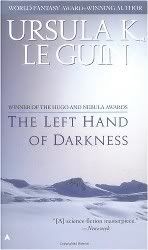
The Left Hand of Darkness by Ursula Le Guin

The Left Hand of Darkness tells the story of Genly Ai, a human envoy to a far-off planed that he names Winter. Genly is in Winter as a representative of the Ekumen, an association whose aim is to promote communication and trade between worlds – not just commercial trade, but trade of ideas, philosophies, experiences, beliefs, cultures. Before Genly’s arrival, the inhabitants of Winter, the Gethenians, were not aware of the existence of other inhabited worlds. Genly’s mission is to convince them that he is trustworthy, and that it would be in their best interest to join the Ekumen. This is not an easy task, because most won’t even believe that he is an alien.

Winter is an austere planet, with constant sub-artic weather. However, that is not the strangest thing about it. What Genly finds strangest is the fact that the Gethenians are androgynes. They have a sexual cycle that lasts approximately 26 days. For 24 of those, they are genderless and asexual. In the remaining two days, they enter kemmer, and can become either male or female. There is no way no predict which they will become, nor do they find it relevant. No Gethenian has a predominant tendency to become male or female. And the same person can mother and father a child, and often does both during their lifetime.

Ursula Le Guin uses this premise to explore issues like gender and its role in society, power, ambition, fear and politics, and more individual issues like sexuality, intimacy and trust.

I will start by saying that I feel very ambivalently towards this book. This is not the first time I tried to read it – the first time was a couple of years ago, and I just couldn’t get into it, so I put it down. I thought it was perhaps a matter of timing. However, this time I struggled once more. But I persisted.

I do not mean by this that I think that The Left Hand of Darkness is a bad book. It won the Hugo and the Nebula, and I can see why. I can see its merits, and I understand why it’s a landmark in science fiction. I certainly don’t want to discourage anyone from reading it. It’s hard to have such mixed feelings, especially about a book by an author I practically worship. I guess the best I can do is try to explain how this book made me feel, and why.

Even though I am a big fan of fantasy and other forms of speculative fiction, I have a little trouble entering sci-fi worlds. It’s not that I can’t do it – I love books like The Hitchhiker’s Guide to the Galaxy, and TV series like Stargate and Babylon 5. It’s just that it takes an extra effort – I am not transported into a sci-fi world as easily as into a fantasy one. I can’t explain why. It’s certainly not a matter of scepticism, of being unable to suspend my disbelief. Aliens, after all, are much more likely than ogres or elves. I grew up obsessed with the X-Files and scanning the skies for flying saucers regularly. And plus, my enjoyment of a story has never depended on how close its relationship with reality is. So this resistance is odd, I know, but it’s how it’s always been for me.

So that, and the fact that I am unfamiliar with Ursula Le Guin’s Hamish universe, could have been part of the problem. But there’s more. The story begins as a report from Genly to the Ekumen. Part of it is written like that, with other chapters from the point of view of Estraven, the Gethenian Genly gets closer to. There are also short interludes with myths and traditional tales from Winter (and in the first half of the book, these were my favourite bits).

My problem, at first, was that the book was written as a report and it actually read like one, rather than like a story. There was this sense of alienness, of distance from the story that I couldn’t shake off. I felt like I was on the outside looking in. What’s interesting here is that this reflects exactly how Genly feels about Winter in the first half of the book. He cannot get over the Gethenians’s lack of gender definition. I think the strangeness I felt was possibly part of what the book was trying to achieve. It’s funny, because I don’t really think of myself as someone to whom gender matters all that much. And yet… the strangeness was there. This book made me think. Even if I don’t believe in the existence of male or female personality types or characteristics, even if I don’t think I look at or classify people in terms of their gender, to what extent can I actually ignore those categories? They are, after all, deeply ingrained in my mind.

As the story advances, the tone becomes less strange, more intimate, quieter and more reflective. There was a part describing a long journey across the ice that I really enjoyed. And again, that is exactly when Genly begins to surpass the strangeness he feels, which once more makes me think that this is part of what Ursula Le Guin was trying to achieve. When Genly began to feel at home among the Gethenians, I too felt at home in the story.

And yet… this book made me uncomfortable, and I can’t quite pinpoint why. It challenged me. There were passages I loved, passages that show Ursula Le Guin at her very best:
When you meet a Gethenians you cannot and must not do what a bisexual naturally does, which is to cast him in the role of Man or Woman, while adopting towards him a corresponding role dependent on your expectation of the patterned or possible interactions between persons of the same or the opposite sex. Our entire pattern of socio-sexual interaction is nonexistent here. They cannot play the game. They do not see one another as men or women. This is almost impossible for our imagination to accept. What is the first question we ask about a newborn baby?
Or:
It is a terrible thing, this kindness that human beings do not lose. Terrible, because when we are finally naked in the dark and cold, it is all we have. We who are so rich, so full of strength, we end up with that small change. We have nothing else to give.
And:
How does one hate one country, or love one? Tibe talks about it; I lack the trick of it. I know people, I know towns, farms, hills and rivers and rocks, I know how the sun at sunset in autumn falls on the side of a certain ploughland in the hills; but what is the sense of giving a boundary to all that, of giving it a name and ceasing to love where the name ceases to apply?
I can see this book growing on me as it sinks further in. I can see myself looking back at it with more and more fondness as time goes by. I really liked the ending, for example – it was hopeful and sad, full of gain and loss. I think this is a book that will stay with me. But if you were to ask me right now how much I enjoyed it, I still wouldn’t know what to say. However, if the question were if I’m glad to have read it, the answer would be a definite yes.

Ringworld by Larry Niven

Ringworld
Larry Niven

Louis Wu is old, 200 years old in fact, but this is the future so it doesn't really matter. What matters is that Louis Wu is also bored as hell and itching for an adventure.

In comes Nessus, a Pierson's Puppeteer. In the Known Space universe of Larry Niven, the Puppeteers have the most advanced technology there is. And Nessus is looking for travel companions for a mission he is not quite ready to reveal but sure leaves Louis Wu and the rest of the recruits interested.

The other recruits? A Kzin species named Speaker to the Animals. Described as ferocious, he joined the mission because he was intrigued. And the payment to them all - technology for a spacecraft that is far too advanced than what is known to humans and the other alien inhabitants of planet Earth - is enough bait for him in hopes of helping the Kzins in somehow defeating the human race sometime.

Then there's Teela Brown, another human. With no flight training to speak of and with hardly any experience at all in space travel save that she has been to Mars or probably partied on the moon (I'm trying to remember her background, I don't want to flip through the book because it's packed somewhere in this house with other books I'm planning to send home as I'm lacking space on my shelves already).

All four set off towards Ringworld, a ring-shaped structure that encircles a star. A structure that is highly advanced and built to hold inhabitants in its vast inner surface. I don't think I'm explaining it well, I need to review my science knowledge. Hahaha!

Imagine a large ring then and set it on a dark, dark surface and call that space. Place a little sun at the center. Imagine the ring's inner flat surface to contain the air that we breath, the seas that we swim in, lands that are both fertile and deserted. And that the ring's system holds all things in place. Then imagine it orbiting, revolving around that little sun. It's a self-surviving system, a created universe. It's an ideal structure for a universe where Earth and other planets faces the possibility of overpopulation.

I was so into the book that it didn't really matter if I wasn't able to recall my early science formula of mass, gravity, inertia and so forth. Hahaha!

It's not just a book of descriptions though. The story of the four in itself is enthralling. Of course I see Ringworld through their eyes but that's not just what the book is about. The four main characters have their own stories to tell and that's part of the book's strength. As the tale unfolds we learn of the wars between the Kzins and the humans, of why Teela Brown was actually recruited, and what does Nessus get from this mission at all?

Interspersed with this is one of my favorite parts in reading a science fiction book - the technology, obviously! This was written in 1970 and yet Larry Niven already imagined a world where teleportation, among other things, is quite normal with transfer booths! And I could actually see and feel the Earth of the future in Louis Wu's eyes.

And yet despite that the book never lacked in feeling. Niven understands the worn-out traveler Louis, of a world that is getting smaller everyday and a planet that somehow is losing its identity and all in a matter of a couple of paragraphs into the book even prior to Wu's recruitment. Niven shows the same care for the other characters, making me glimpse at their lives, their thoughts all throughout the book and making me root for them all the more!

The last paragraph teases us into a sequel or something to that effect. The mission to Ringworld could end there in the first book. But as in all missions where a major discovery is found, there are and will be questions and further probe. And I finished the book August of last year wanting to know more about Ringworld and its engineers. Maybe sometime in the future.

Stranger in a Strange Land by Robert A. Heinlein

Stranger in a Strange Land
Robert Heinlein

This is purportedly the most popular science fiction book of all times.

It won the 1961 Hugo Awards.

I've read this as part of my additional reads for the challenge. I know I keep saying that, so I apologize. I still wouldn't trade my Final Twelve list. I'll go through that, promise.

But as for this being the most popular science fiction book of all time, I do not understand why. I don't grok it at all.

With that I guess it's quite obvious I didn't have the pleasure in grokking the story of the Man from Mars.

Here's the link to my thoughts on the book.

Jonathan Strange & Mr Norrell - Susanna Clarke


Title: Jonathan Strange and Mr Norrell
Author: Susanna Clarke
Country: UK
Year: 2004
Rating: A-
Pages: 782 pgs.

First sentence:
Some years ago there was in the city of York a society of magicians.

What I thought: Other than the fact that it was hard to read this book with a belly the size of a basketball, I really enjoyed it. :) It took me two weeks to finish the book, but that is not a sign of weakness. I have heard many people refer to JS&MR as an "adult Harry Potter". I believe that does a disservice to both this novel and the Harry Potter series. Yes, it involves magicians in the UK, but that is where the similarities end. What makes this story unique is the foray into magical theory and a fantastical history of England. Large portions of the book are occupied with debate over the history of magic in England, and how it should be brought back. Don't let this description turn you off, it's a very hard book to describe, but well worth the time it takes to read it. It does become a bit murky in the middle, but last 200 pages really pick up the pace!

Becky's Review of Speaker For the Dead


Speaker for the Dead by Orson Scott Card.

Speaker for the Dead is the sequel to Ender's Game by Orson Scott Card. But in many ways, it is even more instrumental than Ender's Game. You see, Ender's Game started out as a story--a short story. Orson Scott Card was working on ideas for a new novel, and the basic premise of Speaker for the Dead came to him. Although, at the time the Speaker was a Singer. He thought and worked and thought and worked. And then it came to him, what if the Speaker was Ender! What if he used one of his *old* characters, and gave him a new story. There was one problem. The story needed to be fleshed out before this new novel could work. And it needed more "fleshing" than just a simple prologue or chapter could do. What he needed was to turn his original story into a novel all its own. This is when the characters (we know and love) came into existence. This is when Andrew/Ender was "born."

Speaker for the Dead is a sequel, but it didn't begin life that way--and you don't have to read it that way, either. It was my intention all along for Speaker to be able to stand alone, for it to make sense whether you have read Ender's Game or not. Indeed, in my mind this was the "real" book; if I hadn't been trying to write Speaker for the Dead back in 1983, there would never have been a novel version of Ender's Game at all.
How did Speaker for the Dead come to be? As with all my stories, this one began with more than one idea. The concept of a "speaker for the dead" arose from my experiences with death and funerals. I have written of this at greater length elsewhere; suffice it to say that I grew dissatisfied with the way that we use our funerals to revise the life of the dead, to give the dead a story so different from their actual life that, in effect, we kill them all over again. No, that is too strong. Let me just say that we erase them, we edit them, we make them into a person much easier to live with than the person who actually lived.
I rejected that idea. . . No, to understand who a person really was, what his or her life really meant, the speaker for the dead would have to explain their self-story--what they meant to do, what they actually did, what they regretted, what they rejoiced in. That's the story that we never know, the story that we never can know--and yet, at the time of death, it's the only story truly worth telling.
Speaker for the Dead is the story of a planet, a colony, in need. Lusitania. Home of colonists, Catholic colonists who speak Portuguese and Stark, and home of the "Piggies", pequeninos, "Little Ones." It has been three thousand years since the close of Ender's Game. Humans have supposedly learned much since the xenocide. They have come to regret the destruction of the Hive Queen and the "buggers" and have a new policy when dealing with alien species. This policy plays an important role in Speaker for the Dead. The pequeninos are different--very different from the human colonists. Their is a fence separating the two. Only xenologists--one or two at a time--could visit the pequeninos. Only for a few hours each day. And their were strict guidelines as to how much they could ask and tell. Pipo and Libo are the xenologists. One master, one apprentice. Novinha is the (young) xenobiologist. The three work together closely, but when tragedy strikes--Pipo's murdered by the Piggies--lives are destroyed and things are set into motion that can't be undone.

Andrew Wiggin is THE Speaker for the Dead, though only a few know it. (There are many who have that title of "speaker" but only one is the original. The author of The Hive Queen and the Hegemon.) When he receives the call to 'speak' the death of Pipo, he begins his journey to Lusitania...little knowing that it will forever change his life and determine his destiny.

There are many things I loved about Speaker. I love how Ender has matured into Andrew. I loved seeing how much he's grown...changed. He is wise. But his wisdom doesn't make him less human, it makes him more human. I love how this novel is about taking broken things, messy things, ugly things--and making them whole, making sense of the chaos, making them beautiful. In some ways, it is more philosophical than Ender's Game. Again, it is the characters that make Speaker for the Dead such an outstanding novel. His characters aren't perfect--far from it--but they're real.

Sickness and healing are in every heart. Death and deliverance are in every hand. (240)

Of all of the humans, he is the one who will understand us. (347)

When you really know someone, you can't hate them. (370)

Once you understand what people really want, you can't hate them anymore. You can fear them, but you can't hate them, because you can always find the same desires in your own heart. (370)

Coraline, by Neil Gaiman

Coraline, by Neil Gaiman, is a delightfully creepy little story. Coraline and her parents live in a house that they share with some delightfully eccentric neighbours. There are the two former actors who like to reminisce about their glory days. And there’s the man with the mice. They all keep calling her “Caroline,” which does not please Coraline at all, and they never seem to listen when she corrects them.

Coraline likes to explore things. She spends a lot of time outside until that fateful rainy day when her mother forbids her to go outside. Like most kids would, she whingingly asks what she’s supposed to do. Her mother gives her a list of suggestions, none of which please Coraline. So she goes to her father and asks permission to go outside. When he learns that her mother has already forbidden it, he refuses to give his assent. But his suggestion of what to do on that rainy day pleases Coraline a bit more: explore the inside. Find out how many doors there are, how many blue things, and a few other tasks.

Coraline does so, and is very puzzled by one door that does not open. She goes to her mother to find out what it goes to, and her mother tells her that it goes nowhere. Disbelieving, Coraline makes her skepticism so obvious that her mother digs out the key and opens the door that opens to a brick wall. When the house had been subdivided to make separate living areas, the wall was placed there to prevent access to another part of the house. Her mother doesn’t lock the door, telling Coraline there’s obviously no need to do so.

Coraline gets a mysterious warning from the man with the mice. His mice, he tells her, told him to give her a message: she’s not to go through the door. Coraline is puzzled, but politely brushes him and his warning aside.

What Coraline finds when the brick wall disappears and she goes through to explore the other world, and the adventures she shares with an intrepid cat as her companion, make for a delightfully creepy tale.

The Moon is a Harsh Mistress - kookiejar's review


This is an excerpt from my review of Robert Heinlein's 'The Moon is a Harsh Mistress'...

I'm not a fan of hard science fiction because frequently the writers just throw out terms and ideas that I am unfamiliar with and they don't bother to explain what they mean. It makes me feel like I'm missing out on something. Heinlein is guilty of this as well. He also frequently just drops articles (such as 'the', 'an' and 'a') which I found very irritating as it interrupted the flow of the words.

However, the relationship between Mike, the computer and his human friends was wonderful and that is what kept me fully involved with the story. I wonder if it was intentional that the most sympathetic character in the novel wasn't even a human being.

The rest of the review is at my blog, which you can find (as always) here.

Ender's Game


It is time to talk about an old friend. Orson Scott Card's Ender's Game. A novel that has become without a doubt my most favorite book in the entire world. Okay, so you might think I'm a bit overly dramatic at times. (I've been told this countless times.) But this time, I really, really mean it. (You still don't believe me, do you?) To begin my life with the beginning of my life, I record that I was born. No, I wasn't born loving Ender's Game, but sometimes it feels like it. (Yes, it was that life-changing.) It was seven years ago. The fall of 2000. I was taking a Master's level class in Children's Literature. The professor was Dr. Betty Carter. Ender's Game was a required book for the class. Up until that point, I had never read a science fiction book. Never heard of Orson Scott Card. Never even heard of the Nebula and Hugo awards. I was in for quite a surprise. I liked it, I really liked it. Melodramatic as it sounds, this book opened up a new world for me. I began to devour anything and everything Orson Scott Card. I began to spend my weekends searching used bookstores for copies of his works. And I began to obsessively check his official website maybe not every day but more than three times a week. I especially fell in love with his "Uncle Orson Reviews Everything" columns. And as my whole family--even extended family--can tell you, I began centering whole conversations around Orson Scott Card. Did you know that he.....Guess what OSC thinks about this....If OSC likes a movie, then I'll see it. (Although I don't always always agree with him on everything.) If he recommends a book, I try to read it. (I especially read it if it's a kid or YA book since that's my passion.) So maybe it's not normal to know what your favorite author likes to watch on tv...but if he chooses to write about it...then I might as well read it and remember it like trivia. Why is Ender's Game such a life-changing book? Yes, it is wonderful. Yes, it is practically perfect in every way. Yes, I could read it a hundred times and never get bored with it. But it did much more than that. Now, when you ask me to list my top ten books...or my top twenty books...it's hard for me not to make the majority of my list Orson Scott Card.

Ender's Game is the novel that started it all. It remains my favorite and my best. My second favorite would probably be Pastwatch: The Redemption of Christopher Columbus.

What makes Ender's Game so perfect? The characters. Yes, there is action. Yes, there is a war. But it is the characters that draw you in. It is Ender and Valentine and Peter that make you keep turning the pages. I think OSC gets characters in a way that few other authors do. He creates thoroughly human characters.

Andrew Wiggin "Ender" shows readers that it is not easy to be a hero. That 'saving the world' demands great sacrifice and selflessness. A hero's life is not a happy life. Yet a hero is what the world needs when the story opens. Set hundreds of years in the future, Ender's Game shows an Earth that has survived two alien invasions. The "Buggers" (an insect-like alien race) have been defeated twice. But the war--though over--carries on. As long as this alien race is out there somewhere, the Earth could still be in danger. Therefore, the world has united as one to fight their common enemy. The brightest and best children are taken from countries all over the world to Battle School. This school is a space station. The children--ranging in age from six to sixteen--are trained from the very beginning by the military. Everything has a purpose--from the "video games" that psychoanalyze each student to the battle games the children play in zero gravity. The military--the powers that be--believe Ender to be the savior that the world has been looking for all these years. And they will devote their lives to ensuring that he becomes exactly the kind of hero they need for the final battle that is to come. The problem? Such training is not healthy psychologically. These children aren't really children. They're being raised to kill and destroy the enemy as defined by the powers that be. They're being taught to hate. They're being taught to love war....to love battle...to love competition. They don't know about love. They don't know about kindness. They don't know about mercy and compassion. Most forget what life was like on Earth altogether. They've forgotten about their families, their homes, their customs. In other words, they've forgotten just why Earth is worth defending and protecting. The war has become a game to them almost. A fight for the sake of fighting.

To read a more in-depth review (also written by me) click here. Although I'll warn you now, there are spoilers. It was written for a class. And in writing assignments like those, it is all about summary and analysis. And you can't analyze a book without discussing the ending!

My Author Study Paper on Orson Scott Card

Nymeth's List

Hello everyone!

I'm Nymeth from Things Mean a Lot. Here are my picks for the challenge:
  1. The Amazing Adventures of Kavalier and Clay by Michael Chabon (Pulitzer 2001)
  2. The Color Purple by Alice Walker (Pulitzer 1983)
  3. Beloved by Toni Morrison(Pulitzer 1988)
  4. Kafka on the Shore by Haruki Murakami (World Fantasy Award 2006)
  5. Little, Big by John Crowley (World Fantasy Award 1982)
  6. Thomas the Rhymer by Ellen Kushner (World Fantasy Award 1991)
  7. The Left Hand of Darkness by Ursula Le Guin (Hugo 1970, and Nebula 1969)
  8. Midnight's Children by Salman Rushie (Booker Prize 1981)
  9. The Remains of the Day by Kazuo Ishuguro (Booker Prize 1989)
  10. The God of Small Things by Arundhati Roy (Booker Prize 1997)
  11. Bridge to Terabithia by Katherine Paterson (Newbery Medal 1978)
  12. On Beauty by Zadie Smith (Orange Prize 2006)

Rhinoa's List

I couldn't narrow it down to 12 so I picked 16 and I will see how many I get through during the year. As I read them I will put up reviews on my blog at Rhinoa's Ramblings

The books I have picked are:

1) Perdido Street Station - China Mieville (Arthur C Clarke Award)
2) Quicksilver - Neil Stephenson (Arthur C Clarke Award)
3) Iron Council - China Mieville (Arthur C Clarke Award)
4) Life of Pi - Yann Martel (Man Booker Prize)
5) The Blind Assassin - Margaret Atwood (Man Booker Prize)
6) The God of Small Things - Arundhati Roy (Man Booker Prize)
7) Paddy Clark Ha Ha Ha - Roddy Doyle (Man Booker Prize)
8) American Gods - Neil Gaiman (Bram Stoker Award and Hugo Award)
9) Eats, Shoots & Leaves - Truss (British Book Prize)
10) Wild Swans - Chang (British Book Prize)
11) Beowolf - Seamus Heany (Costa/Whitbread Prize)
12) Alias Grace - Margaret Atwood (Giller Prize)
13) Jonathan Strange and Mr Norrell - Susanne Clarke (Hugo and World Fantasy Award)
14) On Beauty - Zadie Smith (Orange Prize)
15) Beloved - Toni Morrison (Pulitzer Prize)
16) Perfume - Patrick Suskind (World Fantasy Award)
17) Bridge to Terabithia - Katherine Paterson (Newbery Medal)

Camille @ Dabbling Dilettante's List

Here is my challenge list after days of deliberation. I'm so excited about this challenge. I've decided to use it to branch myself out into genres I don't usually read and to expose myself to new authors I haven't encountered yet. I've also selfishly included some Pulitzer-prize winners to further my own personal goal of working my way through all of those. But I kept the number down to three to keep the spirit of a challenge.

1. On Beauty by Zadie Smith (Orange)
I've been wanting to read this for awhile and recently bought White Teeth, which I haven't read yet, either.

2. The Left Hand of Darkness by Ursula K. LeGuin (Nebula)
Having recently finished the Earthsea books, I am a renewed fan of LeGuin's. (I remember liking her as a kid after reading the first Earthsea book.) I'm curious about her other works.

3. The Age of Innocence by Edith Wharton (Pulitzer)
This is the third Pulitzer winner. I'm planning on having finished the first two in June.

4. Alice Adams by Booth Tarkington (Pulitzer)
This the fourth Pulitzer winner. Again, to pursue the completion of my personal goal.

5. The Higher Power of Lucky by Susan Patron (Newbery)
I like YA and children's novels. I'm curious about the most recent winner.

6. Criss Cross by Lynne Rae Perkins (Newbery)
If you read the most recent winner, you might as well read the next to most recent winner. You never know when you'll want to finish that list, too, one day.

7. Birds of a Feather by Jacqueline Winspear (Agatha)
I never read mysteries so this is a genre I wanted to represent in this challenge. I checked through the Edgar winners but they looked too scary for me (probably why I tend to shy away from mysteries). But on the Malice Domestic website Agatha winners are described as "...mysteries that contain no explicit sex, excessive gore, or gratuitous violence; usually featuring an amateur detective, they have a confined setting and characters who know one another." Sounds like my cup of tea.

8. Possession by A.S. Byatt (Man Booker)
I recently bought this at the used bookstore. Thought I'd throw in a few TBRs.

9. The Curious Incident of the Dog in the Night-time by Mark Haddon (Costa/Whitbread)
My brother and his fiancée read this in Iraq while they were stationed in Fallujah and they liked it. I've been wanting to read it for awhile.

10. Spin by Robert Charles Wilson (Hugo)
Branching out into science fiction

11. Forgotten Beasts of Eld by Patricia A. McKillip (World Fantasy)
Further explorations into the fantasy genre

12. The All-True Travels and Adventures of Lidie Newton by Jane Smiley (Spur)
Definitely new territory for me, the western-set novels. Plus I started Thirteen Ways of Looking at the Novel but have never read any of Jane Smiley's fiction.

Alternates

1. Life of Pi by Yann Martel (Man Booker)
own it-TBR
2. Ender's Game by Orson Scott Card (Nebula)
TBR
3. American Gods by Neil Gaiman (Nebula)
I keep hearing about Neil Gaiman from other book bloggers.
4. Dune by Frank Herbert (Nebula)
I think I remember my dad reading this in the early 80s. I never had an interest but now I'm curious.
5. Sophie's Choice by William Styron (National Book Award)
TBR
6. One of Ours by Willa Cather (Pulitzer)
Pulitzer goal; 5th winner

Becky's List

Hi! My name is Becky and my site is Becky's Book Reviews.

In no particular order:

1. Ender's Shadow by Orson Scott Card (Alex Awards, 2000)
2. Ender's Game by Orson Scott Card (Hugo, 1986; Nebula, 1985)
3. Speaker for the Dead by Orson Scott Card (Hugo, 1987; Nebula, 1986)
4. The Life and Death of Adolf Hitler by James Cross Giblin (Robert F. Sibert Medal, 2003)
5. To Kill A Mockingbird by Harper Lee (Pulitzer, 1961)
6. Gone With the Wind by Margaret Mitchell (Pulitzer, 1937)
7.Possession: A Romance by A.S. Byatt (Booker Prize, 1990)
8. A Year Down Yonder by Richard Peck (Newbery, 2001)
9. The Tale of Despereaux by Kate DiCamillo (Newbery, 2004)
10. Walk Two Moons by Sharon Creech (Newbery, 1995)
11. Number the Stars by Lois Lowry (Newbery, 1990)
12. Looking for Alaska by John Green (Printz Award, 2006)


Alternates

1. Crispin: The Cross of Lead by Avi (Newbery, 2003)
2. Holes by Lois Sachar (Newbery, 1999)
3. Out of the Dust by Karen Hesse (Newbery, 1998)
4. Missing May by Cynthia Rylant (Newbery, 1993)
5. Dicey's Song by Cynthia Voigt (Newbery (1983)
6. Adam of the Road by Elizabeth Janet Gray (Newbery, 1943)

Matt's List

Hey, this is Matt from A Variety of Words where I'll be posting reviews of these books as I complete them. Fantastic idea for a reading challenge. This is only the second challenge I've joined and I'm looking forward to getting started. I ended up with about 19 books on my list so I'm posting the 12 plus 7 alternates.

  1. Voices from Chernobyl by Svetlana Alexievich (NBCC)
  2. The Blind Assassin by Margaret Atwood (Man Booker)
  3. Ender's Game by Orson Scott Card (Hugo, Nebula)
  4. Europe Central by William Vollmann (National Book Award)
  5. The Adventures of Augie March by Saul Bellow (National Book Award)
  6. Invisible Man by Ralph Ellison (National Book Award)
  7. One Hundred Years of Solitude by Gabriel Garcia Marquez (Nobel)
  8. Half of a Yellow Sun by Chimamanda Ngozi Adichie (Orange)
  9. Beloved by Toni Morrison (Pulitzer, Nobel)
  10. A Confederacy of Dunces by John Kennedy Toole (Pulitzer)
  11. To Kill a Mockingbird by Harper Lee (Pulitzer)
  12. The Age of Innocence by Edith Wharton (Pulitzer)
And now for some alternates just in case I decide to change it up a bit.
  1. The Handmaid's Tale by Margaret Atwood (Governor General, Arthur C. Clarke)
  2. Perdido Street Station by China Mieville (Arthur C. Clarke)
  3. Spin by Robert Charles Wilson (Hugo)
  4. Bel Canto by Ann Patchett (Pen/Faulkner, Orange)
  5. The Good Earth by Pearl S. Buck (Pulitzer)
  6. Lonesome Dove by Larry McMurtry (Pulitzer, Spur)
  7. Seeker by Jack McDevitt (Nebula)
  8. War Trash by Ha Jin (Pen/Faulkner)
Nearly every one of these book was already on my list, and some I had been putting off, but no longer!

BC (Before Challenge) Reads by 3M

Award winners I read in the first half of 2007 (not counted for the challenge):
Angle of Repose **** (Pulitzer)
Atonement ***1/2 (NBCC)
To Kill a Mockingbird ***** (Pulitzer)
The Echo Maker **** (NBA)
The Road ****1/2 (Pulitzer)
Everyman * (PEN/Faulkner)
The Giver ****1/2 (Newbery)
March ***1/2 (Pulitzer)
The Inheritance of Loss ***1/2 (Booker/NBCC)
The Handmaid's Tale ****1/2 (Governor General)
The Stone Diaries ****1/2 (Pulitzer/NBCC/Governor General)
Amos Fortune, Free Man **** (Newbery)
The Color Purple **** (Pulitzer)
A Wrinkle in Time **** (Newbery)
Number the Stars **** (Newbery)
Jonathan Strange & Mr. Norrell ****1/2 (World Fantasy/Hugo)
The Bone People **** (Booker)
Wild Swans ****1/2 (British Book of the Year)

Award-winners read before 2007:
Gilead by Marilynn Robinson ***** (Pulitzer/NBCC)
The Old Man and the Sea by Ernest Hemingway ****1/2 (Pulitzer)
The Grapes of Wrath by John Steinbeck ****1/2 (Pulitzer)
Beowulf translated by Seamus Heaney ***** (Whitbread)
The Chatham School Affair by Thomas H. Cook ****1/2 (Edgar)
The Whipping Boy by Sid Fleischman (Newbery) *****
Jacob Have I Loved by Katherine Paterson (Newbery) ****
Bridge to Terabithia by Katherine Paterson (Newbery) ****1/2
The Bronze Bow by Elizabeth George Speare(Newbery) *****
Island of the Blue Dolphins by Scott O'Dell (Newbery) ****1/2
The Witch of Blackbird Pond by Elizabeth George Speare (Newbery) ****1/2
...And Now Miguel by Joseph Krumgold (Newbery) ****1/2
Caddie Woodlawn by Carol Ryrie Brink (Newbery) ****1/2


Hugo Award

http://en.wikipedia.org/wiki/Hugo_Award_for_Best_Novel

2011 Blackout/All Clear by Connie Willis
2010 The Windup Girl by Paolo Bacigalupi (tie)
2010 The City & the City by China MiƩville (tie)
2009 The Graveyard Book by Neil Gaiman
2008 The Yiddish Policemen's Union by Michael Chabon
2007 Rainbows End by Vernor Vinge
2006 Spin by Robert Charles Wilson
2005 Jonathan Strange and Mr. Norrell by Susanna Clarke
2004 Paladin of Souls by Lois McMaster Bujold
2003 Hominids by Robert J. Sawyer
2002 American Gods by Neil Gaiman
2001 Harry Potter and The Goblet of Fire by J. K. Rowling
2000 A Deepness in the Sky by Vernor Vinge
1999 To Say Nothing of the Dog: Or How We Found the Bishop's Bird
Stump At Last by Connie Willis
1998 Forever Peace by Joe Haldeman
1997 Blue Mars by Kim Stanley Robinson
1996 The Diamond Age: Or, a Young Lady's Illustrated Primer by Neal Stephenson
1995 Mirror Dance by Lois Mcmaster Bujold
1994 Green Mars by Kim Stanley Robinson
1993 Doomsday Book by Connie Willis and A Fire Upon the Deep by Vernor Vinge
1992 Barrayar by Lois McMaster Bujold
1991 The Vor Game: The Continuing Adventures of Miles Vorkosigan by Lois McMaster Bujold
1990 Hyperion by Dan Simmons
1989 Cyteen by C. J. Cherryh
1988 The Uplift War by David Brin
1987 Speaker for the Dead by Orson Scott Card
1986 Ender's Game by Orson Scott Card
1985 Neuromancer by William Gibson
1984 Startide Rising by David Brin
1983 Foundation's Edge by Isaac Asimov
1982 Downbelow Station by C. J. Cherryh
1981 The Snow Queen by Joan D. Vinge
1980 The Fountains of Paradise by Arthur Charles Clarke
1979 Dreamsnake by Vonda N. Mcintyre
1978 Gateway by Frederik Pohl
1977 Where Late the Sweet Birds Sang by Kate Wilhelm
1976 The Forever War by Joe Haldeman
1975 The Dispossessed: An Ambiguous Utopia by Ursula Le Guin
1974 Rendezvous With Rama by Arthur Charles Clarke
1973 The Gods Themselves by Isaac Asimov
1972 To Your Scattered Bodies by Philip Jose Farmer
1971 Ringworld by Larry Niven
1970 The Left Hand of Darkness by Ursula Le Guin
1969 Stand on Zanzibar by John Brunner
1968 Lord of Light by Roger Zelazny
1967 The Moon Is a Harsh Mistress by Robert A. Heinlein
1966 Dune by Frank Herbert and This Immortal by Roger Zelazny
1965 The Wanderer by Fritz Leiber
1964 Way Station by Clifford D. Simak
1963 The Man in the High Castle by Philip K. Dick
1962 Stranger in a Strange Land by Robert A. Heinlein
1961 A Canticle for Leibowitz by Walter M. Miller
1960 Starship Troopers by Robert A. Heinlein
1959 A Case of Conscience by James Blish
1958 The Big Time by Fritz Leiber
1957 No award was given.
1956 Double Star by Robert A Heinlein
1955 They'd Rather Be Right by Frank Riley
1954 No award was given.
1953 The Demolished Man by Alfred Bester