BookGal's Midway Progress Report

It seems we are midway through the time for this challenge and it's time to update my progress.
I've finished 8 of the 12 books on my list, and loved most of them. I even got my book of the year from this list. I have four to go and may make a substitution. I'm almost done with The Hours which qualifies as a Pulitzer Prize winner. I will probably substitute it for The Road because that one seems to be getting buried on the TBR pile.

So here's the finished list:


1. Middlesex by Jeffrey Eugenides (Pulitzer Prize, 2003)
2. Life of Pi by Yann Martel (Man Booker Prize, 2002)
3. The Tale of Despereaux by Kate DiCamillo (Newbery, 2004)
4. Mrs. Kimble by Jennifer Haigh (PEN/Hemingway, 2003)
5. The Poisonwood Bible by Barbara Kingsolver (Book Sense Adult Fiction Winner, 2000)
6. City of Bones by Michael Connelly (Anthony Award, 2003)
7. The Stone Diaries by Carol Shields (Pulitzer Prize, 1995)
8. California Girl by T. Jefferson Parker (Edgar Award, 2005)


Here's the TBR list:

1. Criss Cross by Lynne Rae Perkins (Newbery, 2006)
2. Higher Power of Lucky by Susan Patron (Newbery, 2007)
3. The Road by Cormac McCarthy (Pulitzer Prize, 2007)
Possible substitution of The Hours by Michael Cunningham
4. March by Geraldine Brooks (Pulitzer Prize, 2006)

The Old Man and the Sea
by Ernest Hemingway
127 pages
First Sentence:
He was an old man who fished alone in a skiff in the Gulf Stream and he had
goneeighty-four days now without taking a fish.

This is the fairly mellow tale of an old fisherman who is trying to do what he was born to do: fish. Without a catch in 84 days, he is now being called "salao, which is the worst form of unlucky." But as he sets off on his 85th day, he is determined that it will be a lucky day. He is sure he will be catching a large fish this time.

This book moves at a leisurely pace in a stream-of-conscienceness way. The old man, being alone, thinks to himself and occasionally talks to himself too. The reader witnesses the old man's mental struggles with loving his fish while he also knows he must kill it. The agonies he goes through to catch the fish and then to protect it for the long trip home feel real.

It is about dreams fulfilled but at a cost. It is about a man's struggle with adversity. I am afraid that the simplicity of the story is hiding a much larger picture than I was able to grasp. It didn't win the Pulitzer Prise in 1953 because of its plot alone. It has a genuine quality about it. You believe this is the story of a real fisherman in the Gulf Stream. Largely uneducated, simple, loves fishing and the sea, content with his lot in life. I think the best description for it is pleasantly simple.

Petunia's Progress

These are all the award winners I read from June to December 2007.

Adam of the Road (Newbery '43)

Carry On, Mr. Bowditch (Newbery '56)

The Complete Stories of Flannery O'Connor(National Book '72)

The Bronze Bow (Newbery '62)

The Age of Innocence(Pulitzer '21)

To Kill a Mockingbird(Pulitzer '61)

Shen of the Sea (Newbery '26)

Beowulf (Costa/Whitbread '99)
We're halfway through already?! Oh my goodness! This has been so much fun, I'm reading some wonderful books.

So far, I've read 7 of 12 (yea, I'm on track!)

  1. Invisible Man, by Ralph Ellison - National Book Award 1953 (completed 7/9/2007 - review)
  2. The Optimist's Daughter, by Eudora Welty - Pulitzer 1973 (completed 8/10/2007 - review)
  3. The Road, by Cormac McCarthy - Pulitzer 2007 (completed 9/2/2007 - review)
  4. East of Eden, by John Steinbeck - Nobel Prize author, 1962 (completed 10/6/2007 - review)
  5. Interpreter of Maladies, by Jhumpa Lahiri - Pulitzer 2000 (completed 10/11/2007 - review)
  6. The Tenderness of Wolves, by Stef Penney - Costa/Whitbread 2006 (completed 11/9/2007 - review)
  7. The Giver, by Lois Lowry - Newbery 1994 (completed 12/15/2007 - review)

I enjoyed all of these, but I rated Interpreter of Maladies as one of my top 5 books for 2007. So far it's my favorite of this challenge. Still to come:

  1. March, by Geraldine Brooks - Pulitzer 2006
  2. The Sea, The Sea, by Iris Murdoch - Booker 1978
  3. The Bone People, by Keri Hulme - Booker 1985
  4. The Gathering, by Anne Enright - Booker 2007
  5. TBD - I'm thinking I'll read the 2008 Pulitzer winner, as long as it's announced before the challenge ends!

Lizzy's Midpoint Progress

18 so far for me. I am loving this challenge! Reading some great books and reducing the TBR - marvellous!

1) Gone With The Wind - Margaret Mitchell (Pulitzer 1937)
2) Sacred Hunger - Barry Unsworth (Booker Prize 1990)
3) The Lizard Cage - Karen Connelly (Orange First Novel Award 2006)
4) The Boy and The Sea - Kirsty Gunn (Scottish Arts Council Book of the Year 2007)
5) Consolation - Michael Redhill (Toronto Book Award 2007)
6) Mister Pip - Lloyd Jones (Commonwealth Writers' Prize 2007)
7) The Tenderness of Wolves - Stef Penney (Costa Debut Novel and Book of the Year 2006)
8) Joseph Knight - James Robertson (Saltire Book Award 2003)
9) The Trick Is To Keep Breathing - Janice Galloway (Whitbread First Novel Award 1989)
10) Foreign Parts - Janice Galloway (McVitie's Prize Scottish Writer of the Year 1994)
11)A Good Thief's Guide to Amsterdam - Chris Ewan (Long Barns Book's First Novel Prize 2006)
12) The Shoe Tester of Frankfurt - Wilhelm Genazino (Georg-Buchner Prize 2004)
13) Restless - William Boyd (Costa Novel 2006)
14) The Lonely Passion of Judith Hearne - Brian Moore (Author's Club Award for First Novel 1955)
15) Set In Stone - Linda Newbery (Costa Children's Novel 2006)
16) The Vanishing Act of Esme Lennox - Maggie O'Farrell (Good Housekeeping Book of the Year 2007)
18) What Was Lost - Catherine O'Flynn (Costa Debut Novel 2007)
17) The Bower Bird - Ann Kelley (Costa Children's Novel 2007)

P.S I read this year's Costa Novel of the Year winner before the challenge began. But in case you're wondering what it's like:

Day - A L Kennedy

3M's Halftime Report

I encourage everyone who wishes to publish their midpoint progress to do so. Please use the label 'midpoint progress' when posting.

I completed the following books in the first half of the challenge:

1. The Blind Assassin by Margaret Atwood (Booker 2000) FINISHED
2. The God of Small Things by Arundhati Roy (Booker 1997) FINISHED
3. The Sea by John Banville (Booker 2005) FINISHED
4. A Death in the Family by James Agee (Pulitzer 1958) FINISHED
5. The Higher Power of Lucky by Susan Patron (Newbery 2007) FINISHED
6. The Door in the Wall by Marguerite de Angeli (Newbery 1950) FINISHED
7. The Known World by Edward P. Jones (Pulitzer, IMPAC, NBCC) FINISHED
8. The Hours by Michael Cunningham (Pulitzer) FINISHED
9. The White Stag by Kate Seredy (Newbery 1938) FINISHED
10. Middlesex by Jeffrey Eugenides (Pulitzer) FINISHED
11. Lisey's Story by Stephen King (Bram Stoker 2007) FINISHED
12. Half of a Yellow Sun by Chimamanda Ngozi Adichie (Orange 2007) FINISHED
13. Bud, not Buddy by Christopher Paul Curtis (Newbery) FINISHED
14. The Tale of Despereaux by Kate DiCamillo (Newbery) FINISHED
15. Buying a Fishing Rod for my Grandfather by Gao Xingjian (Nobel Laureate) FINISHED
16. The Shipping News by E. Annie Proulx (Pulitzer) FINISHED
17. The Bridge of San Luis Rey by Thornton Wilder (Pulitzer) FINISHED
18. Kristin Lavransdatter I: The Wreath by Sigrid Undset (Nobel laureate) FINISHED
19. Suite Francaise by Irene Nemirovsky (Prix Renaudot) FINISHED

6th book - A Dark-Adapted Eye


Winner of the Edgar Award, 1987

This was an interesting mystery as family secrets are revealed a bit at a time. At first, the slowness of the narrative annoyed me, but overtime I began to appreciate the way Faith learned about her family's past along with the reader.


More book information here.

Winner of the Arthur C. Clarke Award, 2001

I have to admit I was nervous about approaching this book again. I had started reading it years ago, but didn't get far. This time, I kept going, and I'm glad I did. Perdido Street Station is a intensely descriptive book filled with so much detail about New Crobuzon and its inhabitants. Woven throughout is the story of Isaac and his quest to help Yagharek fly and what that quest ultimately leads to. It'll be a while before the images of this book leave me and I look forward to reading the next book in the series, The Scar.

More book information here.

I'll Second That ...

I see that Petunia has read Atonement, by Ian McEwan, as her most recent Challenge book, and found the writing to be wonderful. I'll second that, as I kept reading for the pleasure of the language. My thoughts are posted here.

Atonement, NBCCA 2002

The line on the bottom of the front cover says "A beautiful and majestic fictional panorama." And it's true. This may be one of the most beautifully written books I've ever read. Which is not to say pleasant. The subject matter, adult themes and the violence of war, are certainly difficult to get through at times. But they are all a necessary part of the journey.

You can read the rest of my review here.

Newbery 1999, Holes

Holes
By Louis Sachar © 1998
Published by Scholastic, Inc.
1999 Newbery Medal winner


Holes is the story of young Stanley Yelnats and a generations-old family curse. As the story opens, things look grim for Stanley. Convicted of a crime he did not commit, Stanley is sentenced to serve time at Camp Green Lake, a camp for bad boys.

“Stanley was not a bad kid. He was innocent of the crime for which he was convicted. He’d just been in the wrong place at the wrong time.

“It was all because of his no-good-dirty-rotten-pig-stealing-great-great-grandfather!

“He smiled. It was a family joke. Whenever anything went wrong, they always blamed Stanley’s no-good-dirty-rotten-pig-stealing-great-great-grandfather…”

Camp Green Lake didn’t sound so bad. After all, Stanley had never been to camp before. But Stanley soon finds that, “there is no lake at Camp Green Lake.” Instead, there are endless stretches of desert, scorpions, rattlesnakes, and deadly yellow-spotted lizards. The Warden and camp staff are dangerous characters, as well, who oversee the boys, day in and day out, as they dig holes, each exactly five feet deep and five feet wide. The boys have no idea why they’re digging these holes. They’re told that digging holes builds character and turns bad boys into good boys. But before his time at Camp Green Lake is through, Stanley will uncover the real truth about the Warden, Camp Green Lake – and the Yelnats family curse.

Holes, by Louis Sachar, is definitely my favorite Newbery pick so far. It’s a smart, funny page-turner, has wonderful characters, a story line with lots of ups and downs, and a karmic happy ending. A great read!

Based on the true story of Grace Marks who was the most infamous woman in Canada in the 1840's. Her and James McDermott were accused of murdering their male employer Mr Thomas Kinnear and his housekeeper cum mistress Nancy Montgomery who was pregnant at the time. McDermott was said to have killed Mr Kinnear with a shotgun after earlier in the day the two of them strangled Nancy. Possible reasons were that McDermott was in love with Grace and Grace was in love with Mr Kinnear.

The tale picks up with Grace in jail sometime after McDermott has been hanged for his crimes. Grace was due to be hanged as well, but the sentence was changed to life due to the efforts of her lawyer Kenneth MacKenzie. It is told alternatively through Grace herself and Dr Simon Jordan who specialises in mental issues (Grace spent some time in an asylum but it was unclear whether she was truely insane or faking it). Dr Jordan is a young man trying to open his own asylum and adopts Grace as his new project that will hopefully give him the exposure he requires to get funding. The interest in her is that it was never proven just what her involvement was in the murder of Nancy and Mr Kinnear, she claims to have had a blackout and not remember anything for a couple of hours during the time Nancy was killed.

I absolutely loved this book. Grace was such an interesting character, you were never sure how much of what she was telling Dr Jordan was the truth. Atwood gives the impression that she was guilty, but it is never said outright. There are some interesting side characters like Dr Jordan's landlady and his mother who towards the end manages to get her own way, she is a very formidable opponent! I also spent a lot of time wondering whether Grace's friend Mary Witney was ever real or was Grace's original name and who the "J" from the apple core divination was that Grace would marry. Highly recommended to all Atwood, fiction and crime fans.

"Thomas the Rhymer" by Ellen Kushner

Ellen Kushner’s novel Thomas the Rhymer is a retelling of the old Scottish ballad of the same name – the story of a Harper who, after kissing the Queen of Elfland (and in some versions, more), is spirited away to Faerie where he lives as her lover/slave for seven years. After that time, he returns to the world of men with two cruel gifts: the gift of foresight, and “the tongue that never lies” – the complete inability to tell lies.
This novel won both the Mythopoeic and the World Fantasy Awards. When I picked it up, the very first thing I saw were the extremely enthusiastic blurbs by people like Neil Gaiman, Jane Yolen, Terri Windling, Charles de Lint and Orson Scott Card, all writers for whom I have the greatest respect. Needless to say, my expectations were very high. And I’m saying this so that you understand how much it means to say that I was not disappointed at all.

Ellen Kushner approaches this familiar story from an original angle. The book is divided in four parts, each with a different first person narrator: Gavin, Thomas, Meg and Elspeth. Gavin and Meg are an old couple who lives in the countryside of a mythical old Scotland – the Scotland of tales and ballads. The story opens with Gavin describing how a Harper, Thomas, asks them for shelter one stormy night. He turns out to be ill, and Meg nurses him back to health. As time goes by, the childless couple becomes very fond of the young man, who begins to visit them regularly. He seems to develop feelings for a local girl, Elspeth, and these also seem to be reciprocated – except that the young man and woman’s loveplay is in the form of constant arguments.

As the years go by, Thomas comes and goes. He visits the courts of powerful men and harps for them, and when he needs a place to rest, or to hide from trouble, he returns to Meg and Gavin’s. Until one day, in the middle of one of his visits, he goes for a walk on the hills alone and doesn’t come back. His possessions, and, most importantly, his harp, are left behind. Meg, Gavin and Elspeth never see him again – not for seven years, anyway.

As you must have gathered, each of these four narrators tells us a piece of the story. Gavin takes it until Thomas’ disappearance; Thomas describes his years in Elfland; Meg narrates Thomas’ surprising return; and Elspeth’s story takes place many years later, when Thomas is an old man. Together, these four narratives form a complete, rich and multilayered whole. Along with the different perspectives, the different narrators bring different moods and emotional tonalities to the story, which complement each other perfectly. Gavin’s tone is matter-of-factly, and his tale is intriguing. Thomas’ story is a deeply sensual one, and a meditation on longing and despair. Meg’s story is tender, and Elspeth’s is both sorrowful and resigned.

As Neil Gaiman put it, this is “an elegant and beautiful book that manages both to create firmly real, breathing people, and to evoke the magic of faerie." Indeed, one of the book’s greatest strengths is the perfect combination of the eerie and the very human – often in the same moment.

This is a novel about Faerie, but it’s also a novel about the world of men. It’s a story about the cost and weight of the truth, about the importance of stories, of ballads, of music and of art, and about longing and passion and love and regret. Tom’s acute humanity is made all the clearer by the otherness of Elfland. There he learns things about himself that he never dared suspect – things that are truth of humanity as a whole.

As if all of this wasn’t enough, the novel is also superbly written, and full of passages I’m dying to share, such as:
But the question had been asked; the hole had been opened in the fabric of things, and there is something about a hole, a tear, a rent in anything that is irksome to people of character. One wants to fill it, to mend it, to close it. I have heard Elves say that humans' greatest strength and weakness both is their curiosity, which leads them to invention. Elves are not very good liars; they're not even very good storytellers, as we account storytelling: most of it is not invention, for with the rich stuff of Elfland in their hands, they've no need to invent.
One of my favourite moments in the novel is a brilliant scene in which Tam Lim, another Scottish ballad about a young man and the Queen of Elfland, is sung and played in Thomas’s hall. But of course, explaining the full significance of the scene without giving away the whole plot (which goes beyond the plot of the ballad) would be difficult.

I highly recommend this novel to fans of books like Stardust, Jonathan Strange & Mr. Norrell and Lud-In-The-Mist. And also to fans of timeless stories, and good, unputdownable and memorable books.

QuiltGranny Progress and 2008 goals

I read these books in 2007
2007 - The Road (McCarthy)
2006 - March (Brooks)
2005 - Gilead (Robinson)
2004 - The Known World (Jones)
2003 - Middlesex (Eugenides)
2002 - Empire Falls (Russo)

I read these books the year they were published:
1994 - The Shipping News (Proulx)
1993 - A Good Scent from a Strange Mountain (Butler)
1992 - A Thousand Acres (Smiley)
1989 - Breathing Lessons (Tyler)
1988 - Beloved (Morrison)
1986 - Lonesome Dove (McMurtry)
1983 - The Color Purple (Walker)
1981 - A Confederacy of Dunces (Toole)
1972 - Angle of Repose (Stegner)
I read these books in college in the 1960's (and will probably re-read some of them)
1961 - To Kill a Mockingbird (Lee)
1953 - The Old Man and the Sea (Hemingway)
1952 - The Caine Mutiny (Wouk)
1948 - Tales of the South Pacific (Michener)
1947 - All the King’s Men (Warren)
1945 - Bell for Adano (Hersey)
1940 - The Grapes of Wrath (Steinbeck)
1939 - The Yearling (Rawlings)
1937 - Gone with the Wind (Mitchell)
1932 - The Good Earth (Buck)
1921 - The Age of Innocence (Wharton)

2008 Goals
1999 - The Hours (Cunningham)
1998 - American Pastoral (Roth)
1997 - Martin Dressler: The Tale of an American Dreamer (Millhauser)
1995 - The Stone Diaries (Shields)
1969 - House Made of Dawn (Momaday)
1965 - The Keepers Of the House (Grau)
1956 - Andersonville (Kantor)
1928 - The Bridge of San Luis Rey (Wilder)
1919 - The Magnificent Ambersons (Tarkington)

Title:- The Satanic Verses
Genre:- Fiction
Subgenre:- Novel
Author:- Salman Rushdie
Publisher:- Viking Press
ISBN Number:- 0-312-27082-8
Price:- £5.99

The Blurb

No book in modern times has matched the uproar sparked by Salman Rushdie's The Satanic Verses, which earned its author a fatwa from Iran's Ayatollahs decreeing his death. Furore aside, it is a marvellously erudite study of good and evil, a feast of language served up by a writer at the height of his powers and a rollicking comic fable. The book begins with two Indians, Gibreel Farishta, who has been for fifteen years the biggest star in the history of the Indian movies, and Saladin Chamcha, a Bombay expatriate returning from his first visit to his homeland in fifteen years, plummeting from the sky after the explosion of their jetliner, and proceeds through a series of metamorphoses, dreams and revelations. When the jumbo jet blows apart above the English Channel, Gibreel and Saladin are the two who survive and are washed to an English beach. However, it soon becomes clear that curious changes have come over them and that they have been chosen as protagonists in the eternal struggle between God and the Devil.

Rushdie's astonishing powers of invention are at their best in this Booker Prize shortlist and Whitbread Prize winner. Salman Rushdie is the author of Midnight's Children, winner of the 1981 Booker Prize, and Shame.

The Review

The Satanic Verses is a novel which falls in the genre of Magical Realism (a beautiful paradox of our modern times), of which we see much in Gabriel García Márquez's works.

It tells the story of the enchanting Gibreel Farishta who rises from being a pauper in Bombay to a popular filmstar playing Hindu deities in Bollywood mythologicals. The humor in the novel commences when Gibreel refuses to make love to his female admirers with the elephant snout on, which he has used as a prop for playing Lord Ganesha in a movie and which his fans have come to fancy. He complains that an acting career in Bombay is quite less of acting and much more of frantic travel between studios trying to keep schedules.

It also tells the story of the misplaced Saladin Chamcha, who develops an English accent so refined and immaculate that he lends his voice to British radio shows. He shuns his father who loathes books and had sent him away from Bombay to study in Britain. He returns after a long period of absence only to find that the city of his childhood has changed in a quintessential measure.

On his return trip to UK, Saladin Chamcha meets Gibreel Farishta who has absconded in order to meet his flame Annie Cone, the Mount Everest conquerer whom he courted in Bombay. The plane gets hijacked and all but the two protagonists of the novel - Chamcha and Farishta - are dead. The two are washed ashore on the waves of the English Channel, only to find that there has been a major change of roles. Gibreel thereafter suffers hallucinations of being an archangel, while Saladin is transformed into a chimera representing the devil.

Saladin miraculously recovers from the transmogrification and plots his revenge against Gibreel for refusing recognition and help when Saladin was led into custody by policemen. Like Iago, he plots the murder of Annie Cone at the hands of the suspicious and jealous Gibreel Farishta himself. In the climax, Gibreel shoots himself when he realizes what a mistake he has committed.

The novel also runs the course of three mini-plots: The first comprises the tale of Mahound's revelations from Archangel Gibreel, Hind - Mahound's fiercest opponent and Baal - the irreverent poet. The second speaks of the Imam and his gang of terrorists. And the third and most beautiful story is that of Ayesha, the girl who leads poor villagers on a Haj pilgrimage after convincing them that if God willed it, the waters of the Arabian Sea would part to make way for them.

The novel has ample instances of Rushdie-style humor and sarcasm. The narrative though broken into four parallel threads of narration is held together in a very cohesive manner. Rushdie's implicit commentary on the racism prevalent in UK is commendable and should have been the focus of attention, rather than the much publicized and denounced fatwa issued by Ayatollah Khomeini against him. However, the novel is not as erudite as it could have been. It is in no way grand or profound, and does not seek to reveal something that the reader is unaware of. Definitely not one of Rushdie's better novels.

The book was banned in many countries including Iran and India, for propagating the theory of The Satanic Verses - those verses of the Holy Quran which were revealed to the Prophet by the Satan and which he later retracted as being part of the Holy Book of the Moslems. It was fortunate that Salman Rushdie survived the fatwa issued by Ayatollah Khomeini, since the Japanese translator Igarashi was murdered, and the Italian translator Capriolo suffered serious physical injuries due to being stabbed.

1776 by David McCullough

Holley’s Review #6 of 12
1776 by David McCullough
Quill Award, 2005

I do not often read nonfiction; it is just not my favorite genre. It is often dry and uninteresting with little punch to make it a page-turner (for me, anyway). David McCullough has taken this slice of history, when our nation was just beginning its struggle for freedom, and crafted a book that is hard to put down.

I don’t know if I just wasn’t paying attention in school (likely) or if my teachers never bothered to mention it (unfortunately, also likely), but I never knew George Washington was such a novice at warcraft. In my mind’s eye, I see a tall, distinguished and crafty old fox, busily outmaneuvering the stolid, overly-dressed British. Instead, I learned that Washington was hesitant, indecisive, and utterly unprepared for what the fledgling Congress was asking him to do. I felt a definite pang for all these boys and men, fighting through the depths of melting summer and harsh winter against a well-trained and supplied regiment of Red Coats. I have suggested this book to many of our junior high and high school students who recently had an assignment requiring them to read a history book. They came in down-cast at the prospect and I sent them out excited…a pretty good day for any librarian!

Happy Reading!
htw

American Gods - Neil Gaiman


Shadow is about to be released after serving 3 of his 6 year sentence in prison to begin rebuilding his life with his wife Laura. He has a job waiting for him working in a gym and things are looking up. A couple of days before he is due to be released however, he learns that his wife was killed in a car accident and he is released early to go home for the funeral. On the flight he meets enigmatic Wednesday who claims to be a god. He offers Shadow a job working for him doing errands, which he eventually takes after his other options are eliminated. They seal their deal with mead and set off on a journey across America.

Wednesday feels a storm coming that will be a battle between the old gods brought over by settlers to America (Bast, Horus, Ganesh, Anasi, Easter, Thoth, Anubis etc) and the new (railroads, cars, internet, television etc). Shadow seems somehow caught up in the middle of things with the added problem of the dead not staying dead. The novel is filled with myth and magic from the anicent world and how it might interact in a more modern setting.

I loved this novel from the beginning. I have a passion for mythology and my favourite genre is fantasy so it was right up my street. I knew a lot of the gods and was able to recognise Wednesday for his true name which helped a little. I liked that it explored their darker sides and wasn't light and fluffy. It was a little strange reading a book by an english author that was so american even though I knew this was Gaiman's aim. It expanded nicely on the ideas from "Small Gods" by Terry Pratchett so if you liked that you will definitely like this too. Truely unputdownable!

The Giver - Wendy's Book Review

"Well..." Jonas had to stop and think it through. "If everything's the same, then there aren't any choices! ..." -From The Giver, page 97-

Jonas lives in a Utopian society where everything is managed and everything is safe - a world without color, or music, or even love. The year Jonas turns twelve, he is selected to become the Receiver of Memory...and as his training progresses, life for Jonas forever changes.

The Giver is a book about keeping the world we live in safe and sanitary vs. the value of freedom...and ultimately about the power of hope and faith. Lowry's writing is rich and provocative and stimulates the reader to think about what is truly important in our lives. This is children's literature at its best. Through the power of simple language, a tightly woven plot, and characters who come to reside within the reader's heart, Lowry makes us take notice of our world and to appreciate the simple things we often take for granted.

Lowry won a number of awards and accolades for this slim volume - not the least of which was the Newbery Medal in 1994. The Giver is worthy of this prestigious award.

Highly recommended for children aged nine to 100 years old; rated 4.5/5
Amsterdam
By Ian McEwan
Completed January 1, 2008


Amsterdam is a story that could be a course in irony. I realize that many Ian McEwan fans didn't think this novel was up to the writer's standards, but I enjoyed the dark humor and, well, the irony that permeated this short novel.

Clive Linley and Vernon Halliday were friends, attending the funeral of a mutual, former lover named Molly Lane. Molly was no stranger to having lovers, and the prestigious, up-and-coming Foreign Secretary Julian Garmony was among her conquests. With each man, Molly brought out the best in each lover: Clive created beautiful music, Vernon climbed the newspaper editor ranks and Julian was an expert politician. At the time of Molly's death, each man teetered toward the next step of his career - the very wrung that would make him a legend.

However, Molly's death revealed something scandalous about Julian: incriminating photos of him were found in Molly’s private collection and leaked to Vernon's paper. Vernon told Clive about the photos, which Clive recommended not be printed. Because of Julian's despicable politics and the opportunity to move his career to new heights, Vernon dismissed his friend's advice. Without telling you the end, the proverbial house of cards fell down on all three men. Without Molly, they stood to risk their careers, friendships and legacies - all in one foul swoop.

The ending, to me, was fit and proper for this story, carefully foreshadowed throughout the novel. In games of jealousy, egoticism and revenge, McEwan's Amsterdam shows that no one is the winner. ( )

(cross-posted from my blog)

The Borrowers - Wendy's Book Review

"And, under this clock, below the wainscot, there was a hole..." -From The Borrowers, page 8-

Enchanting and full of the unrestrained joy of a child's imagination, Mary Norton's award winning book The Borrowers ranks among my favorites of childhood. In this lovely 50th Anniversary Edition, Norton explains the process which led her to write the story.

Looking back, the idea seems to be part of an early fantasy in the life of a very short-sighted child, before i was known that she needed glasses. -From the Introduction of The Borrowers, page xv-

When one cannot see panoramas or stars in the vast sea of sky, it is natural to look more closely at the tiny details concealed within the shrubs or along creek beds, or beneath the floorboards hidden among the dust motes. And this was what Norton did as a child. Her splendid imagination created entire worlds...and later, just before war broke out in Europe, her mind returned to these little people of her childhood...and The Borrowers was born.

Norton's endearing story centers around the Clocks - a family of tiny people who live beneath the floor of an old English country home. Arrietty, the Clocks only daughter, longs to go with her father on his borrowing escapades in the big house. And one day, he takes her with him. But, the unimaginable and most frightening thing occurs. Arrietty is "seen" by a boy and life for the Clocks is never again quite the same. Told in accessible language which draws the reader in, The Borrowers is classic children's literature which will be enjoyed by "kids" of all ages.

Norton wrote an entire series of Borrowers books which continue to capture the adventures of the Clock family. As a child, I read them all - over and over again. If you have not experienced the joy of a Norton story, you are missing something wonderful.

The 50th Anniversary edition of The Borrowers (published in 2003 by Harcourt Inc) contains the original British illustrations, never before published in the United States, and is recommended as a beautiful edition for the library.

This book is highly recommended; rated 5/5.

On the Flap:
"Back on the beat as sheriff of Tamarack County, Cork O'Connor has already seen his beautiful Northwoods jurisdiction through an eventful summer. Now, as the chill of autumn sweeps through the countryside, he's about to face a season of murder, adultery, and deceit that will take him from seedy backwoods bars and humble reservation shanties to the highest and most corrupt echelons of Chicago society."

From Me:
I hate starting something in the middle. I am one of those people that likes to read a series in order. However, I jumped in and started reading William Kent Krueger's books smack dab in the middle of a series and I didn't even know it. I chose these two books because they are award winners but they are fine as stand alone books. There are times when you have a vague sense that you are missing some of the back story but Krueger does a great job of filling in the reader in a way that is not heavy-handed.

Cork O'Connor is a truly human and likable guy. He is not so perfect as to be annoying. He has struggles and he faces them head-on. Yet he is a good man who tries to do the right thing. His marriage to Jo is strong yet they face the same problems that we all face such as balancing family and career, children growing up and getting ready for college and so on. Plus he faces things that most of us don't face like how do you protect your family when there has been a hit put out on you?

Mercy Falls was a fun and engaging read and I enjoyed it a lot. It is only edged out by Blood Hollow because the latter had so much that was thought-provoking aside from being a great mystery. Mercy Falls was "only" a great mystery (as if great mysteries are easy to turn out.) It does end with a bit of a cliff hanger and I am looking forward to reading the next book in the series to find out what the heck happens.(4.5/5)
The Hours by Michael Cunningham
Pulitzer 1999

I think I'd like the movie better. The narration is brilliant as Cunningham connects three women, three eras, and so many other symbols that I missed most of them. An homage to Mrs Dalloway and Virginia Woolf, my lack of knowledge and familiarity with both made this a less than impressive read. I acknowledge my lacking in this regard, not Cunningham's.
full review is here at my blog


Blooodletting & Miraculous Cures by Vincent Lam
Giller Prize Winner 2006

An interesting collection of stories, bound together by four beginning doctors, Lam's experience as an emergency room doctor gives a credible perspective, much like an ER episode. I like short stories, and novels loosely held together by some seemingly random threads, so I whipped through this book. I like finding the connection between chapters - how are these related?
full review here at my blog

'The Love of a Good Woman' - Alice Munro

Winner of the Giller Prize, 1998

I like how Amazon describes this collection as “classic Munro: secrets, love, betrayal, and the stuff of ordinary lives”. Munro is like the proverbial fly on the wall, making no judgements on right or wrong, but simply letting the characters make their choices and then dealing with the consequences. Each story was engaging and while I have already forgotten some of them, others refuse to leave, bits of them still lurking in my thoughts. I’m glad I gave her a second chance. I won’t be quite so hesitant to read more by her in the future. (3.5/5)

Read my full review here.

Upcoming Yahoo Group Reads

BookAwards Group:
Jan 15: The Giver (Newbery)
Feb 15: The curious incident of the dog in the night-time (Whitbread)
March 15: Life & Times of Michael K (Booker)

Pulitzer Literature Group:
January 1: The Bridge of San Luis Rey by Thornton Wilder (Pulitzer)
February 1: The Magnificent Ambersons by Booth Tarkington (Pulitzer)
March 1: So Big by Edna Ferber (Pulitzer)

Booker Prize Group
February 1: Life & Times of Michael K (Booker)

Books in Translation Group
February 1: Independent People by Halldor Laxness (Nobel Laureate)

Classic Literature Group
February 1: The Bluest Eye by Toni Morrison (Nobel Laureate)

The Bridge of San Luis Rey - Wendy's Review

Some say that we shall never know and that to the gods we are like the flies that the boys kill on a summer day, and some say, on the contrary, that the very sparrows do not lose a feather that has not been brushed away by the finger of God. - From The Bridge of San Luis Rey, page 9 -

Thornton Wilder earned the Pulitzer Prize in 1928 for The Bridge of San Luis Rey, which has been called his masterpiece. The novella (only 107 pages) begins in the summer of 1714 when a bridge of great construction fails and plunges five people to their deaths in the gorge below. A witness to the tragedy, Brother Juniper, embarks on a quest to prove divine intervention by exploring (in great depth) the lives of the people killed.

The book is essentially a lesson in philosophy - exploring the meaning of love, the twists and turns of one's life amid the greater scheme of things, and whether death is fate or God's plan. There are not any real answers to any of the questions - just the questions.

Wilder writes in old fashioned language and the novella is set in a foreign country with all the subtle references to politics and religion of the time. I admit to getting dragged down in it all and struggled to slog through and finish the book.

Wilder's character development is one of the strengths of the book; and Wilder does this within a very few pages which speaks to his gift as a writer. My favorite characters were the twins Esteban and Manual and I think Wilder does an apt job of presenting their relationship to each other and the devastation of loss that occurs between them. Wilder connects all the central characters to each other...something that took me by surprise...sort of like the six degrees of separation theory. Because of this I expected a resolution to the ultimate question: Could it have been fate that plunged these people to their deaths? Or something larger? But, Wilder apparently never intended to provide an answer. In the afterword of the book I read, the publisher shares a letter from Wilder to one of his readers:

'The book is not supposed to solve. A vague comfort is supposed to hover above the unanswered questions, but it is not a theorem with its Q.E.D. The book is supposed to be as puzzling and distressing as the news that five of your friends died in an automobile accident.'

Perhaps had this been a non fiction philosophy text, I could accept Wilder's cop out on this issue. But, this is a work of fiction and I wanted the character of Brother Juniper to at least come to his own conclusion. Instead, the reader is left with an odd feeling of detachment.

Because this has been touted as a great work of literature, I wanted not only to like it, but to "get it." I'm sorry to say, neither of those things happened.

Not recommended; rated a generous 3/5.

Paddy Clarke Ha Ha Ha by Roddy Doyle


The story of a ten year old boy in sixties Ireland, his childhood antics and adventures, and the ultimate isolation and premature dissociation with the world he has known, owing to the separation of his parents. A growing up tale through an uncolored lens, that is deeply touching. Winner of the 1993 Booker Prize.

Read the Complete Review
William Kent Krueger
341 pages

A beautiful teen-aged girl disappears on New Year's Eve and no one is able to explain why. She seems to have everything but looks can be deceiving.

Cork O'Connor is the former sheriff of Tamarack County, Minnesota. However, he just can't help becoming involved in the tragic disappearance of Charlotte Kane or the apparent railroading of local bad boy, Solemn Winter Moon.

Cork doesn't want anything to do with God or the Church but when Solemn claims to have seen Jesus in a vision and seems changed, Cork doesn't think it's true or that it can last:

He thought about Joan of Arc. If somehow she had managed to escape the burning and live to see wrinkles and the other slow wounds of time on her skin, would she have ceased to hear God speak, laid down her sword, become some man's vessel carrying some man's child? He wondered how long it would take Solemn's certitude, his moment of grace to pass an leave him as empty and lost as everyone else. -pg 160, Blood Hollow

There are times when I could deeply empathize with Cork in his struggle of faith but I think that Father Mal Thorne, priest of the Catholic church in Cork's hometown of Aurora, Minnesota, sums it up best in a statement that he makes to Cork even before we understand the depths of his doubt:
"It would be easy if we all had visions, or if we all believed in those who did. My own feeling is that faith was never meant to be easy." -pg 130, Blood Hollow

And for all the doubt in both God and man that Cork wrestles with, he still remains a compassionate human being with a strong sense of justice:

"The dead can't speak for themselves," he said. "They've got no way to ask for justice. What's left behind in the details of their deaths is the only hope they have for pointing the way toward the truth, and someone ought to pay attention. It's called due diligence, Jo. It's what a good cop does. He considers all the possibilities, turns over all the stones, and he tries to do it without prejudice." - pg 138, Blood Hollow

I saved these two books by William Kent Krueger for last this month because I don't usually have too much trouble breezing through a good mystery. However, I didn't breeze through this one. There was a lot to mull over in the pages of this story and I thoroughly enjoyed every minute of it.It's easy to see why it's an award winner and it will be among my best of 2007. (5/5)

The Hours by Michael Cunningham

Cross-posted from my book blog.

Published in 1998. 226 pages.
Awarded both the Pulitzer Prize for Fiction and the PEN/Faulkner Award in 1999.


Brilliantly conceived and beautifully written, The Hours juxtaposes a few pieces of the life of writer Virginia Woolf with the lives of two other women. One is Clarissa Vaughan - nicknamed Mrs. Dalloway by her friend Richard after the character in Woolf's novel (first published in 1925); Clarrisa lives in Greenwich Village in the present day. The other woman, Laura Brown, who lives in California in 1949, is reading Mrs. Dalloway and struggling with her perception of her roles as wife and mother.

The 2002 film starred Meryl Streep as Clarissa Vaughan, Julianna Moore as Laura Brown, and Nicole Kidman as Virginia Woolf. Kidman won the Oscar for Best Actress in a Leading Role.

Here are a few quotes about the book that put into words a lot of my own thoughts:
"[The Hours] is both a clever tribute to the life and work of Virginia Woolf, and a brilliant examination of the quietly desperate lives of three women." - Seattle Times

"Cunningham here undertakes perhaps one of the most daunting literary projects imaginable.... Cunningham's portrait of Woolf is heartbreaking.... With The Hours, Cunningham has done the impossible: he has taken a canonical work of literature and, in reworking it, made it his own." - Yale Book Review

"Brilliant... haunting - winding skeins of words that, as they unspool, render vividly the three heroines' complex interior lives." - St. Louis Post-Dispatch

The Hours was not on my original Book Awards Reading Challenge list, but because the Yahoo Book Awards group was reading it - and the Yahoo Classic Lit group was reading Mrs. Dalloway - I decided that I'd like to read them both. (I started with Mrs. Dalloway, but I got bogged down in Woolf's writing style, so I set it aside for The Hours. I'm committed to finishing Mrs. Dalloway before the end of the month though.) I'm also committed to watching the film version this coming week.

I can't say that The Hours is a "favorite" book - but I do think that it is noteworthy, and I'm glad that I read it.

The Book Thief by Markus Zusak (Mo's review)

Early this month I read Markus Zusak’s “The Book Thief” as part of a bookring I had signed up for, and it also counts as my 5th selection for the Book Awards Challenge in which I’m participating, as it won the 2006 National Jewish Book Award.

Actually, I surprised myself with how much I enjoyed this book. While I read an eclectic range of genres/styles, I admit I typically shy away from most books that are [1] marketed as YA novels, and especially from those that are [2] particularly saddening or disgraceful in content (i.e. Novels about slavery, child abuse, the holocaust, etc.). So, when I began this tale, narrated by Death and set in World War II Germany, I was a bit apprehensive that I would enjoy it at all, but I was engaged by Zusak’s writing style, and captivated by the story. I won’t write a synopsis here, as there are several well-written descriptions available elsewhere, suffice it to say that this not-so-young adult enjoyed the book, as well. Perhaps not my favorite read of the year, but the story will most certainly stay with me.

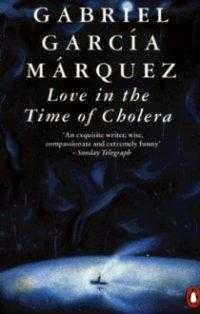
Love in the Time of Cholera - Gabriel Garcia Marquez


Title: Love in the Time of Cholera
Author: Gabriel Garcia Marquez, translated by Edith Grossman
Country: Colombia
Year: 1985
Rating: A-
Pages: 348

There are already some great reviews of this book out there: Eva at A Striped Armchair, Tanabata at In Spring it is the Dawn, Nymeth at Things Mean A Lot, and Chris at Book-A-Rama have all read Love in the Time of Cholera this year.

Complete review here.

First sentence: It was inevitable: the scent of bitter almonds always reminded him of the fate of unrequited love.

Short summary: How long would you wait for love? Florentino Ariza is preared to wait 51 years, 9 months, and 4 days. Love in the Time of Cholera is above all a love story set in the late 19th and early 20th century; a story about all the different ways that people can love each other.

What I thought: This novel is in a style completely different from One Hundred Years of Solitude (I would not classify it as a "magical realism" novel), but it retains the lyrical, passionate, and evocative prose that Marquez is so well known for. It is a love story, but it is not only a love story--more of an in-depth look at love and obsession, and how it can change and evolve over a lifetime.

I always love the imagery in many South American novels, and Marquez is one of the masters. I would definitely recommend this book to anyone who likes magical realism, thoughtful prose, and strong character development. It is a book that demands your attention - if you don't have the time to immerse yourself, hold on to it for another day.

The Tale of Despereaux by Kate DiCamillo


I read this one for the Newbery Project as well as for the Reading Awards Challenge. It is the winner of the Newbery Award, which honors the best in children's literature. This is the same author as Because of Winn-Dixie so I guess this also qualifies as a 2nds, even though I completed that challenge.

Despereaux is a mouse who goes on a quest to save his beloved Princess Pea from the rats in the dungeon. A servant, Miggery Sow, gets involved in the rat's evil plans. The story is one part fairy tale, one part quest story, one part fantasy, and one part bedtime story. The author relates that her son's friend asked for a story about a hero with large ears, and this book is that story.

The entire review is posted on my blog.

Laura's Review - The Giver


The Giver
Lois Lowry
179 pages

First sentence: It was almost December, and Jonas was beginning to be frightened.

Reflections: Jonas is a 12-year-old boy who lives happily with his parents and sister. He goes to school and plays with his friends, just like kids everywhere. But Jonas' world is unique in many respects. Correct word usage is of utmost importance. Families are made up of two parents, and two children -- always a boy and girl. All children experience their birthday the same day in December, through an elaborate community ceremony. When children turn 12, they are assigned their adult job during the ceremony. And the year that Jonas turns 12, he is assigned a very special role: that of The Receiver, the single member of the community who harbors all the memories of humankind.

Training for The Receiver role requires Jonas to spend time with the current Receiver, whom he now calls The Giver. The Giver is very old, and must transfer all memories to Jonas before he can be released from his responsiblities, and from the community. His gifts to Jonas are unique and special -- memories of snow and colors, for example -- and sometimes the memories are painful, such as war and death. The memories, and the deep feelings associated with them, have long been eradicated from the rest of the community in an attempt to create "sameness" among all people, and therefore harmony. Jonas and The Giver devise a plan to bring those memories back and enrich the lives of others. In carrying out this plan, Jonas himself becomes a true Giver himself.

This book packs quite a punch compared to most young adult literature. Would "sameness" really bring harmony and peace to our world? Or would it bring the emptiness pervading Jonas' community? Should we not then celebrate the differences in our world, rather than fight over them? This powerful, thought-provoking book will linger in my memory for a very long time. ( )

The original review can be found here.

He stood a stranger in this breathing world,
An erring spirit from another hurled;
A thing of dark imaginings, that shaped
By choice the perils he by chance escaped.
-A line from Byron's poem 'Lara'-

J.M. Coetzee's novel Disgrace explores the ideas of race, gender and generational differences. In simple, yet powerful prose, Coetzee develops his main character - a professor of communications named David Lurie - amid the social and political complexities of South Africa.

David Lurie is a middle aged man of questionable morality, whose passions lie with young women...girls, really. When he begins an affair with one of his students - the beautiful Melanie - David finds himself on the other side of a sexual harassment investigation. He retreats to his daughter Lucy's farm in the country where terror and unexpected violence unfold.

Throughout the novel, Coetzee intersperses the poetry of Byron, and the tangled life of this poet as he pursues a girl much younger than himself. David Lurie's desire to write an opera about Byron and his lover is largely symbolic of David's own struggle within himself.

Although he devotes hours of each day to his new discipline, he finds its first premise, as enunciated in the Communications 101 handbook, preposterous: 'Human society has created language in order that we may communicate our thoughts, feelings and intentions to each other.' His own opinion, which he does not air, is that the origins of speech lie in song, and the origins of song in the need to fill out with sound the overlarge and rather empty human soul. - From Disgrace, page 4 -

In fact, the novel's largest theme seems to be about the confusing nature of language - filled with misunderstanding, second meaning, and the breakdown of communication - specifically that between the sexes, the generations, and the races. It is clear throughout the book that David's perceptions, as a man, are different from Lucy's (or Melanie's) female perceptions; and that David's understanding of African culture as a white man, are different from the black Petrus (who lives on Lucy's land). David's struggles to communicate and connect with his daughter are fraught with misunderstanding.

Coetzee won the Nobel Prize in Literature in 2003 - and it is easy to see why after reading Disgrace. His style is spare and shocking, and the novel is not one that a reader can put down and forget.

Highly recommended; rated 4.5/5.
Winner of the Nobel Prize for Literature, 1968

Reading this really made me regret that I can’t read Japanese (or speak it for that matter). Although Edward G. Seidensticker is well regarded as a translator, I got the feeling that it would be more beautiful, more lyrical in the original. Kawabata’s style is often compared to haiku poetry and you get definite glimpses of that here but I couldn’t help wondering constantly what it read like in Japanese. So throughout the story I could never quite forget that I was reading a translation. That said, I enjoyed the book and many of the images from it still linger in my mind. It’s a story of beauty and sadness that should be savoured, not rushed.
But, drawn to her at that moment, he felt a quiet like the voice of the rain flow over him.
When he received the Nobel Prize for Literature in 1968, the Nobel committee apparently cited 3 of his novels including Snow Country. I look forward to reading the other two (Thousand Cranes and The Old Capital) at some point. (3.5/5)

Cross-posted on my blog.
Winner of the National Book Award, 1970

As there often is in Oates’ stories, there’s a lot of violence in this book, and desperation and delusion and it’s quite depressing how the characters never seem to escape their past, how certain events continue to affect their lives long afterwards. Alternating the narrative among the main characters helped keep the story moving and made the characters really take shape even if I didn’t particularly like or sympathise with them much of the time.

If I remember correctly, I heard this book mentioned a few years ago during a discussion of Middlesex, primarily since it’s also partly set in Detroit during the riots, and I'd had it in the back of my mind to read it ever since. It took me quite a while to get through and it’s certainly not uplifting but I’m glad I finally got around to reading it. (3.5/5)

Read my full review here.

Clara Callan, by Richard Wright

This was my November read, and I really enjoyed it! It won the 2001 Governor General's Award (Canada), and the 2001 Giller Prize. It's the journal and letters of the title character, writing to her sister who has moved to New York City, right before World War II. I found it to be a great read, and particularly evocative of time and place.

If you are interested in reading my ramblings, my review is here.

Happy Holidays, everyone!

Bridget Jones's Diary
By Helen Fielding
Completed December 13, 2007

Bridget Jones’s Diary is a cute, fluffy novel that had me laughing at many parts and groaning in others. Of the several “chick lit” books I have read, Bridget is as adorable, vulnerable and likeable as her “chick” counterparts. However, what sets her apart, in my opinion, is that she learned from her adventures and came out a wiser person (though, with a sequel, this could have been temporary!).

Bridget Jones is a single thirty-something who can’t find a meaningful relationship, works in a dead-end job and must cope with her mother’s mid-life crisis. She writes about her life in her diary, including a faithful documentation of her daily alcohol, tobacco and caloric consumption. In effect, she gains 74 pounds but loses 72, binges on alcohol (especially when times get tough) and never strikes it rich. Her affair with her boss, Daniel, leaves her feeling miserable and lonely, and by the end of the book, she finally gets her act together to end the year on a positive note.

Thanks to Raidergirl3 (Elizabeth) for recommending that I read Bridget Jones’s Diary around the holidays. It was perfect for this time of year – a light read with short chapters (great for bookmarking in between baking batches of cookies) and some good laughs. It was a fun book. Interestingly, it was awarded the British Book Award (Book of the Year) in 1998. You go girl! ( )

(Cross-posted from my blog)
My experience with cyberpunk has not been large. I have read Neal Stephenson's Snow Crash and The Diamond Age, and liked them well enough. This Canadian novel is the archetypal cyberpunk novel and won the triple crown of sci-fi literary awards: the Nebula Award, the Philip K. Dick Award, and the Hugo Award. For most of the novel, I was not too enticed. I kept waiting for myself to care, and to feel really invested into the plot. It did not happen, at least not the extent that I wanted it to. As a a result, I have feeling I'll forget the plot of this book fairly soon. I think the blunt and straightforward prose are an advantage, but I was not wholly interested in the story. There are interesting concepts about AI, genetic engineering, cyberspace, and the concepts of the power of the free market to over rule the current world structure. Gibson wrote about all these before it was popular in the mainstream. If only I did not feel I have already read it all before because this fifteen years on. This would probably be a good introduction to cyberpunk as it has all the elements.

Esperanza Rising - Pam Munoz Ryan

Title: Esperanza Rising
Author: Pam Munoz Ryan
Country: America
Year: 2000
Rating: A
Pages: 262

My review can be found here.

The Pura Belpre Award is not on the list of awards, but I was still planning on counting it for this challenge. I hope that is ok!

Blood Work

Terry McCaleb used to be a top FBI profiler but the stress has taken it's toll on him. He suffers a heart attack which leaves him him in need of a heart transplant. He receives his heart transplant and is recovering at his boat when Graciela, the sister of his heart donor, shows up and asks him to help her find her sister's killer. Things get twisty from there.

I really enjoy reading mysteries. That's what lured me to this title but I purposely tried not to find out too much about it because I didn't want to accidentally come across any spoilers. I didn't even realize that a movie had been made from this book. So I guess I was successful!

This was an easy and fun read for me. I found the characters very likable and I enjoyed the fact that there were a couple of plot twists. I also found the story to be pretty unique. It definately kept me turning the pages. I will be looking for more by Michael Connelly.(4/5)

4th book - Bridge to Terabithia


Winner of the Newbery Award, 1978

This was a beautifully written book on friendship, imagination, and courage as both Jess and Leslie learn to take risks. I felt I got to know the characters well in a short amount of time.

More book information here.

#14 Judith Hearne / # 15 Set In Stone

#14 The Lonely Passion of Judith Hearne (Authors' Club Award for First Novel 1955)
2007 was the year in which I discovered Brian Moore. I picked him for my reading the author challenge and now have a habit which must be satisfied! I've even set up a blog just for discussions on all 20 of his novels. (And I though these challenges were supposed to help reduce theTBR.)


The Lonely Passion of Judith Hearne was my third and final novel for both the Reading the Author challenge and the Book to Movie. (Don't you just love crossovers!) And it' s a strong contender for my personal book of the year. I didn't think anything would approach the lofty heights of Karen Connolly's The Lizard Cage - but Moore has.


Thoughts on the movie here. Thoughts on the book on my new blog TheMooreTheMerrier.


#15 Set in Stone - Linda Newbery (2006 Costa Award for Children's Novel)


I didn't quite get into this as much as I was expecting and I think it's because it is a young adult's novel and shied away from the really murkier aspects of its gothic material. Further thought here. However, I'm glad I read it. It means I can start on the 2007 Costa award winners as soon as they are announced!

East of Eden (Kristi's book #4 )

I've just finished reading East of Eden by John Steinbeck (winner of the 1962 Nobel Prize in Literature). I've enjoyed every Steinbeck book I've ever read and this one was no exception. It's a long, complicated book that follows the lives of two families (one of which was Stienbeck's maternal ancestors) over three generations. Ultimately, the book is about the good and evil that reside in each of us—and the balance between the two. As is always the case with Steinbeck’s novels, my favorite part was the author’s masterful use of language. You can find my complete review on my blog.

Silverwing & Dust

Books Number 10 and 11 for me in this challenge are award winning Canadian children's books.


Silverwing by Kenneth Oppel
First in the Silverwing Trilogy


Pages: 274
First Published: 1997
Genre: YA, animal fantasy
Awards: Mr. Christie's Book Award, CLA Children's Book of the Year, OLA Silver Birch Award
Rating: 4/5

First Sentence:


Skimming over the banks of the stream, Shade heard the beetle warming up its wings.


Comments: When Shade a young Silverwing bat is blown off course during his colony's migration south, he is determined to find his way back to them. An impending war between the bats and birds, and a hungry vampire bat recently escaped from a observatory make his journey even more challenging. I couldn't put this one down. An utterly compelling story with interesting characters. The book ends with a set-up for the next in the trilogy and I'm looking forward to reading it. Recommended


Dust by Arthur Slade


Pages: 168
First Published: 2001
Genre: YA, science fiction
Awards: Governor General's Award, Saskatchewan Book Award, Mr. Christie's Book Award
Rating: 5/5

First Sentence:


Matthew Steelgate had five cents in his pocket and a yearning for chewing gum and licorice.


Comments: When Robert's 7-year old brother disappears from a 1930s Saskatchewan prairie town it is only the first of many strange things that happen. He starts to have strange dreams, his parents seem to forget his brother, the local reverend starts making animal noises and an ivory-skinned man has arrived in town promising to make a rain machine. The first chapter describes the disappearance of the little boy and is utterly chilling. I was hooked at that point and couldn't stop reading. It's a short book and I don't want to give anything away by saying too much so I'll just say Slade has written a book which is a cross between Stephen King and W.O. Mitchell. I was at turns reminded of Who Has Seen the Wind and Needful Things. I will definately be reading others by this author.

-Nicola

Thanks 3M

Thanks 3M for the link to post to the blog. Just wanted to officially ask to join the challenge.

I've read The Road by Cormac McCarthy, the PPW for Fiction this year (2007) and am in the process of listening to Last Orders by Graham Swift a Booker.

Thanks again.

Jan in Edmonds ;-)

http://jottingsfromjan.blogspot.com